Blooming em tecidos revestidos com poliuretano: uma revisão da literatura sobre um desafio de conservação em coleções
DOI:
https://doi.org/10.14568/cp44660Palavras-chave:
Plásticos, Têxteis, Depósitos esbranquiçados, Moda, Design, Ácido adípicoResumo
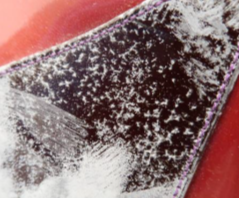
Este artigo apresenta uma revisão crítica da literatura sobre o blooming em tecidos revestidos com poliuretano termoplástico (TPU). O blooming, tipicamente descrito como depósitos esbranquiçados à superfície, constitui um fenómeno de deterioração comum em TPUs de coleções de moda e design. Com base em estudos da ciência dos polímeros, fontes industriais e investigação em conservação, analisa-se como o blooming tem sido definido, investigado e abordado na prática da conservação. A literatura identifica dois mecanismos recorrentes para o blooming: a migração de aditivos como processo físico, e a hidrólise como processo químico, frequentemente associada à formação de ácido adípico. Estudos centrados em conservação permanecem limitados, existindo poucos casos focados na limpeza e no acondicionamento. A revisão evidencia variabilidade na terminologia, nas causas e nas práticas de conservação descritas na literatura. Ao sintetizar o conhecimento atual e identificar as principais lacunas, esta revisão contribui para o desenvolvimento de estratégias interdisciplinares de conservação.
Downloads
Referências
1. Rasmussen, S. C., ‘Revisiting the early history of synthetic polymers: critiques and new insights’, Ambix 65(4) (2018) 356-372, https://doi.org/10.1080/00026980.2018.1512775.
2. Shashoua, Y., Conservation of plastics: materials science, degradation and preservation, Elsevier/Butterworth-Heinemann, Amsterdam (2008).
3. Chaudhary, M. L.; Gupta, R. K., ‘Polyurethanes: an introduction’, in ACS symposium series, eds. M. L. Chaudhary & R. K. Gupta, American Chemical Society, Washington, DC (2025) 1-14, https://doi.org/10.1021/bk-2025-1507.ch001.
4. de Souza, F. M.; Kahol, P. K.; Gupta, R. K., ‘Introduction to polyurethane chemistry’, in Polyurethane chemistry: renewable polyols and isocyanates, eds. R. K. Gupta & P. K. Kahol, American Chemical Society Publications, Washington, DC (2021) 1-24, https://doi.org/10.1021/bk-2021-1380.ch001.
5. Ghazal, H.; Saad, F.; Hegazy, B. M.; Sedik, A.; Hassabo, A. G., ‘Polyurethane and its application in textile industry’, Letters in Applied NanoBioScience 13(1) (2024) 1-28, https://doi.org/10.33263/LIANBS131.008.
6. França de Sá, S.; Verkens, K.; Rizzo, A.; Petersen, G.; Scaturro, S.; Correia, I.; Carita, M., ‘Synthetic coatings in fashion collections: identification and preservation issues’, in Handbook on museum textiles, Scientific and Technological Research, Wiley (2023) 319-344.
7. Reddy-Best, K. L.; Ordoñez, M. T., Conservation concerns in fashion collections: caring for problematic twentieth-century textiles, apparel, and accessories, Costume Society of America, Ohio (2022).
8. Rodríguez Salinas, C.; Ferrazza, L., ‘Real or faux leather? Luxury or ready-to-wear mass production? Characterization of three TPU shoe coatings (ca. 1970) from the Kunstmuseum Den Haag fashion collection’, Conservar Património 47 (2024) 60-77, https://doi.org/10.14568/cp34780.
9. Curating semi-synthetic and synthetic fibres and fabrics, Dress and Textiles Specialists (DATS) and Plastics Subject Specialist Network (PSSN), London (2022), Microsoft Word - Curating Semi and Synthetic Fibres v1.docx, (accessed 2025-10-23).
10. Ionescu, M. (ed.), Chemistry and technology of polyols for polyurethanes, Rapra Technology, Shawbury (2005).
11. Meier-Westhues, H.-U.; Danielmeier, K.; Kruppa, P.; Squiller, E., Polyurethanes: coatings, adhesives and sealants, 2nd ed., Vincentz Network, Hannover (2019), https://doi.org/10.1515/9783748600473.
12. Tomás Ferreira, J.; De Vrieze, S.; Van Der Velde, E.; Verkens, K.; França de Sá, S., ‘Beyond the surface: a closer look at the stratigraphy of synthetic-coated fabrics in fashion collections and commercial samples through optical microscopy’, Conservar Património 47 (2024) 43-59, https://doi.org/10.14568/cp34830.
13. Fung, W., Coated and laminated textiles, CRC Press, Woodhead, Oxford (2008).
14. McSweeney, R. T.; Athey, R. J., ‘Urethane coatings for textile substrates’, Journal of Coated Fabrics 3 (1973) 16-30, https://doi.org/10.1177/152808377300300103.
15. ‘Blooming (damage types)’, in Damage Atlas Glossy Surfaces, https://studycenter.momu.be/DAT/page/Blooming (accessed 2025-10-23).
16. França de Sá, S., ‘Mapping polyurethane coated fabrics and damages in fashion collections worldwide by optical microscopy and infrared spectroscopy’, in Semi-synthetic and synthetic textile materials in fashion, design and art, ICOM-CC Modern Materials & Contemporary Art and Textiles Working Groups, Online (2023) in press.
17. França de Sá, S.; Tomás Ferreira, J.; Carita, M.; Correia, I.; Van Der Velde, E.; Verkens, K., ‘A preliminary approach for blooming removal in polyurethane-coated fabrics’, Conservar Património 47 (2024) 28-42, https://doi.org/10.14568/cp34728.
18. Bechthold, T., Polyurethan im möbeldesign der 60er jahre - technologie - alterung - konservierung. Unter besonderer Berücksichtigung polyurethanbeschichteter textiler Trägersubstrate, Master Dissertation, Restaurierung, Kunsttechnologie und Konservierungswissenschaft, Technische Universität München, München (2002).
19. ‘Degradation of polyurethanes’, in Damage Atlas Glossy Surfaces, https://studycenter.momu.be/DAT/page/degradation_of_polyurethanes (accessed 2025-10-23).
20. França de Sá, S., What does the future hold for polyurethane fashion and design? Conservation studies regarding the 1960s and 1970s objects from the MUDE collection, PhD dissertation, Department of Conservation and Restoration, NOVA School of Science and Technology, Caparica (2017).
21. Lavédrine, B.; Fournier, A.; Martin, G. (eds.), POPART: Preservation of Plastic Artefacts in Museum Collections, Comité Des Travaux Historiques et Scientifiques, Paris (2012).
22. Tomás Ferreira, J.; Damas, C.; Carita, M.; Correia, I.; Van Der Velde, E.; Verkens, K.; França de Sá, S., ‘Oh no, not blooming again! Assessing the influence of storage conditions in the reappearance of blooming on TPU coated fabrics’, poster in Future Talks 023: Materials Matter. Cold and Current Cases in the Conservation of the Modern, Die Neue Sammlung, Munich (2023).
23. Tomás Ferreira, J.; Laganà, A.; Mazurek, J.; Rizzo, A.; França de Sá, S., ‘To clean or not to clean? Reversing a trend of conservation failures when dealing with blooming in thermoplastic polyurethanes’, oral communication in Future Talks 025: From failure to success. Innovative case studies in the conservation of the modern, Die Neue Sammlung, Munich (2025).
24. Inbloom, https://sites.fct.unl.pt/inbloom/home (accessed 2025-12-11).
25. Seah, D. G. J.; Dasari, A., ‘Establishing the bleeding and diffusion of chromophores from lining/upper fabrics in shoes to MidSole in sneakers – a case study’, The Journal of The Textile Institute 116(7) (2025) 1243-1251, https://doi.org/10.1080/00405000.2024.2372996.
26. Work, W.; Horie, K.; Hess, M.; Stepto, R., ‘Definition of terms related to polymer blends, composites, and multiphase polymeric materials’, Pure and Applied Chemistry 76(11) (2004) 1985-2007, https://doi.org/10.1351/pac200476111985.
27. Wypych, G. (ed.), Handbook of plasticizers, ChemTec Pub, Toronto (2004).
28. Farkas, J., ‘Thermoplastic polyurethane with reduced tendency to bloom from a bio-based glycol’, Ohio, patent, US 2014/0107311 A1 (2014).
29. Farkas, J.; Jacobs, C. P., ‘Thermoplastic polyurethane with reduced tendency to bloom’, Ohio, patent, US 8,790,763 B2 (2014).
30. Farkas, J.; Day, R. W.; Gross, R. A.; Ganesh, M., ‘Polyols with reduced cyclic oligomer content and thermoplastic polyurethane compositions thereof’, Ohio, patent, WO 2017/040505 A1 (2017).
31. ‘DAMIANI industrial paints: explanatory notes 2k top coats’ (2019), https://www.betonboja.com/files/NE_DAM_TOP_COAT_2K_EN.pdf (accessed 2025-10-24).
32. França de Sá, S.; Ferreira, J. L.; Ramos, A. M.; Coutinho, B.; Macedo, R., ‘How to keep what was intended to be temporarily functional? Reflections on decision-making for the conservation of polyurethane ready-to-wear fashion’, in Authenticity and replication: the ‘real thing’ in art and conservation, eds. R. Gordon, E. Hermens & F. Lennard, Archetype, London (2014) 193-203.
33. Keneghan, B., ‘A survey of synthetic plastic and rubber objects in the collections of the Victoria and Albert Museum’, Museum Management and Curatorship 19(3) (2001) 321-331, https://doi.org/10.1016/S0260-4779(01)00054-1.
34. Krieg, T.; Mazzon, C.; Gómez-Sánchez, E., ‘Material analysis and a visual guide of degradation phenomena in historical synthetic polymers as tools to follow ageing processes in industrial heritage collections’, Polymers 14(1) (2021) 121, https://doi.org/10.3390/polym14010121.
35. Carita, M., A coleção de moda de Maria Gambina no MUDE – Museu do Design e da Moda: levantamento, caracterização material e desenvolvimento de estratégias de acondicionamento, Master Dissertation, Department of Conservation and Restoration, NOVA School of Science and Technology, Caparica (2022), https://run.unl.pt/bitstream/10362/155793/1/Carita_2022.pdf (accessed 2025-11-13).
36. Rizzo, A.; Scaturro, S., ‘Already out of fashion: the fashionable rise and chemical fall of thermoplastic polyurethane’, in ICOM-CC 19th Triennial Conference Preprints, ed. J. Bridgland, ICOM-CC, Beijing (2021) 1-11.
37. Lattuati-Derieux, A.; Thao-Heu, S.; Lavédrine, B., ‘Assessment of the degradation of polyurethane foams after artificial and natural ageing by using pyrolysis-gas chromatography/mass spectrometry and headspace-solid phase microextraction-gas chromatography/mass spectrometry’, Journal of Chromatography A 1218(28) (2011) 4498-4508, https://doi.org/10.1016/j.chroma.2011.05.013.
38. Pellizzi, E.; Lattuati-Derieux, A.; Lavédrine, B.; Cheradame, H., ‘Degradation of polyurethane ester foam artifacts: chemical properties, mechanical properties and comparison between accelerated and natural degradation’, Polymer Degradation and Stability 107 (2014) 255-261, https://doi.org/10.1016/j.polymdegradstab.2013.12.018.
39. van Oosten, T.; Shashoua, Y.; Waentig, F., Plastics in art: history, technology, preservation, Siegl, Munich (2002).
40. van Oosten, T., PUR Facts. Conservation of polyurethane foam in art and design, Amsterdam University Press, Amsterdam (2011).
41. Sen, A. K., Coated textiles: principles and applications, 2nd ed., CRC Press, Boca Raton (2008).
42. Rose, A.; King, A., Plasticisers in historic plastics: spectroscopic and chromatographic approaches for cellulose acetate and polyvinyl chloride, PhD dissertation, Institute of Sustainable Heritage, University College London, London (2023).
43. Wei, X.-F.; Linde, E.; Hedenqvist, M. S., ‘Plasticiser loss from plastic or rubber products through diffusion and evaporation’, npj Materials Degradation 3(1) (2019) 18, https://doi.org/10.1038/s41529-019-0080-7.
44. Szycher, M., Szycher’s handbook of polyurethanes, 2nd ed., CRC Press, Boca Raton (2013).
45. Tomás Ferreira, J.; Rizzo, A.; Ferreira, G.; Carvalho, F.; Macário, D.; França de Sá, S., ‘Vinyl- and polyurethane-coated fabrics in fashion collections: exploring material subtleties through a multi-analytical approach’, Heritage 8 (2025) 511, https://doi.org/10.3390/heritage8120511.
46. Silva, C., Personal communication, Tintex, Vila Nova de Cerveira, Portugal (2025).
47. ISO 6452:2021. Rubber- or plastics-coated fabrics − Determination of fogging characteristics of trim materials in the interior of automobiles, International Organization for Standardization, Geneva (2021).
48. Farkas, J.; Jacobs, C. P., ‘Thermoplastisches polyurethan mit verringerter ausblühneigung’, Paris, patent, EP 2 408 831 B2 (2012).
49. Lavédrine, B.; Fournier, A.; Martin, G., ‘Appendix 3: analysis of degradation products found during surveys of three French collections’, in POPART: Preservation of plastic artefacts in museum collections, eds. B. Lavédrine, A. Fournier & G. Martin, Comité Des Travaux Historiques et Scientifiques, Paris (2012).
50. ‘Case study - damaged blooming c1’, in Damage Atlas Glossy Surfaces, https://studycenter.momu.be/DAT/item/75893 (accessed 2025-10-23).
51. ‘Case study - damaged blooming c2’, in Damage Atlas Glossy Surfaces, https://studycenter.momu.be/DAT/item/75899 (accessed 2025-10-23).
52. ‘Case study - heavily damaged blooming c1’, in Damage Atlas Glossy Surfaces, https://studycenter.momu.be/DAT/item/75889 (accessed 2025-10-23).
53. ‘Case study - heavily damaged blooming c2’, in Damage Atlas Glossy Surfaces, https://studycenter.momu.be/DAT/item/75891 (accessed 2025-10-23).
54. ‘Case study - slightly damaged blooming c1’, in Damage Atlas Glossy Surfaces, https://studycenter.momu.be/DAT/item/75892 (accessed 2025-10-23).
55. ‘Case study - slightly damaged blooming c2’, in Damage Atlas Glossy Surfaces, https://studycenter.momu.be/DAT/item/75886 (accessed 2025-10-23).
56. Bechthold, T., ‘Wet look in 1960s furniture design: degradation of polyurethane-coated textile carrier substrates’, in The future of the 20th century: collecting, interpreting and conserving modern materials, eds. C. Rogerson & P. Garside, Archetype Publications, London (2006) 128-133.
57. Bechthold, T., ‘Tube, dixon and co. – And how are your elderly patients doing?’, oral communication in Future Talks 023: Material Matters. Cold and current cases in the conversation of the modern, Die Neue Sammlung, Munich (2023).
58. Morris, R.; Keneghan, B., ‘Cold war fashion: two case studies from an exhibition at the Victoria & Albert Museum’, in Future Talks 009: The conservation of modern materials in applied arts and design proceedings, Die Neue Sammlung, Munich (2009) 93-100.
59. Spring, K.; Flexer, G., ‘Approaching the preservation of polyurethane ester soles on football boots’, in University of Cambridge, Cambridge (2023) 63-76, https://doi.org/10.17863/CAM.104118.
60. Llamas-Pacheco, R., ‘Facing new challenges in the conservation of the boots of former Valencia Club de Fútbol player Gaizka Mendieta’, Ge-conservacion 25(1) (2024) 30-43, https://doi.org/10.37558/gec.v25i1.1186.
61. ‘Conservation guidelines’, in Damage Atlas Glossy Surfaces, https://studycenter.momu.be/DAT/page/conservation_guidelines (accessed 2025-10-23).
Downloads
Publicado
Como Citar
Licença
O presente trabalho é distribuído nos termos da Licença Creative Commons (CC BY-NC 4.0) que permite a utilização, partilha e reprodução para fins não comerciais e sem modificações, desde que o autor e fonte original sejam citados.
O Copyright permanece com os autores.