Os têxteis coptas do Museu Paul e Alexandra Canellopoulos: uma abordagem analítica
DOI:
https://doi.org/10.14568/cp40402Palavras-chave:
Têxteis coptas, Técnicas analíticas, hh-XRF, Microscopia ótica, UHLPCResumo
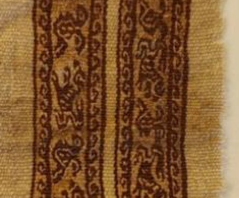
A coleção particular de Paul e Alexandra Canellopoulos foi doada ao Estado grego em 1972 e, pouco depois (1976), foi inaugurado o museu com o mesmo nome. A coleção inclui mais de 6500 antiguidades e obras de arte de diferentes períodos históricos e culturas, incluindo um número notável de têxteis arqueológicos coptas. Estes têxteis sobrevivem até hoje devido ao costume copta de os enterrar com os mortos e à aridez das sepulturas egípcias. Os parâmetros ambientais secos em que todos estes itens foram enterrados ou armazenados deram-nos a oportunidade de os estudar até aos dias de hoje. O Museu Canellopoulos abriga 19 fragmentos têxteis, que datam do século V/VI ao século XII. Os quatro fragmentos foram escolhidos para uma investigação analítica detalhada. Os têxteis selecionados foram submetidos a uma combinação de técnicas analíticas não invasivas e pouco invasivas para determinar o tipo de fibras, os componentes inorgânicos e os corantes a eles associados.
Downloads
Referências
1. Amin, M., ‘Notes on two children’s tunics in the Coptic Museum, Cairo’, International Journal of Heritage, Tourism and Hospitality 15(2) (2021) 106-114, https://doi.org/10.21608/ijhth.2022.250788.
2. Mabrouk, N., ‘Investigation and analysis of two coptic textile fragments in the agricultural museum in Egypt’, Shedet 7(7) (2020) 277-297.
3. Margariti, C.; Moraitou, S.; Retsa, M., ‘Overview of textiles excavated in Greece’, in Textiles: History, properties and performance and applications, ed. I. H. Mondal, Nova Science Publisher, New York (2014) 259-276.
4. Karydis, C., Introduction to the preventive conservation of textile works of art, Futura, Athens (2006).
5. Skampavias, K.; Chatzidaki, N. (eds), Paul and Alexandra Canellopoulos Museum.Byzantine and Post-Byzantine art, P. & A. Canellopoulos, Athens (2007).
6. Brouskari, E., ‘The textiles in Paul and Alexandra Canellopoulos Museum’, in CAMU 1 - Byzantine, Medieval and Modern studies - the centenary of the Paul and Alexandra Canellopoulos Collection, eds. E. Gerousi, P. Petridis, A. Bekiaris & N. Papadimitriou N., Paul and Alexandra Canellopoulos Museum, Athens (in press).
7. Völker, A., ‘Late antique and early Islamic textiles’, in Fragile remnants. Egyptian textiles of Late Antiquity and Early Islam, ed. P. Noever, Hatje Cantz, Vienna (2005) 9-18.
8. Amin, E., ‘The documentation and treatment of a Coptic child’s tunic in Egypt’, Egyptian Journal of Archaeological and Restoration Studies 9(1) (2019) 1-11, https://doi.org/10.21608/EJARS.2019.38423.
9. Cooper, T.; Morris, M., ‘Egypt, and Coptic Textiles’, Art History 47(1) (2024) 98-124, https://doi.org/10.1093/arthis/ulae004.
10. Thomas T. K., ‘Coptic and Byzantine textiles found in Egypt: corpora, collections, and scholarly perspectives’, in Egypt in the Byzantine world 300-700, ed. R. S. Bagnall, Cambridge University Press, Cambridge (2007) 137-162.
11. Ball, J. L., Byzantine dress: representations of secular dress in eighth- to twelfth-century painting, Palgrave MacMillan, New York (2005).
12. Bailleul-LeSuer, R., Between heaven and earth: birds in ancient Egypt, The Oriental Institute of the University of Chicago, Chicago (2012).
13. Alexiou, K.; Margariti, C.; Loukopoulou, P., ‘From the burial to the textile conservation lab: the case of a late Roman charred textile from Katapola Amorgou’, in Proceedings of the conference ‘Textile’, eds. P. Adam-Veleni, D. Karolidis, A. Arvanitaki Archaeological Museum of Thessaloniki, publication no 34, Thessaloniki (2017) 31-37.
14. Chaves, L. de, ‘An investigation on a Coptic embroidered panel from the 13th century “Crucifixion with the Twelve Apostles” (Benaki Museum, Athens)’, Heritage 4(4) (2021) 4335-4343, https://doi.org/10.3390/heritage4040239.
15. Karapanagiotis, I.; Abdel-Kareem, O.; Kamaterou, P.; Mantzouris, D., ‘Identification of dyes in Coptic textiles from the Museum of Faculty of Archaeology, Cairo University’, Heritage 4(4) (2021) 3147-3156, https://doi.org/10.3390/heritage4040176.
16. Karydis C.; Oikonomou A.; Konstanta A., ‘The unpublished Coptic textiles of the monastery of St. John the Theologian: preliminary results of previous alterations and scientific analysis’, Journal of Mediterranean Archaeology and Archaeometry 19 (2019) 133-142, https://doi.org/10.5281/zenodo.2585999.
17. Bonizzoni, L., ‘ED-XRF analysis for cultural heritage: is quantitative evaluation always essential?’, Journal of Physics: Conference Series 630 (2015) 012001, https://doi.org/10.1088/1742-6596/630/1/012001.
18. Luciani, G.; Pelosi, C.; Agresti, G.; Monaco, A. L., ‘How to reveal the invisible. The fundamental role of diagnostics for religious painting investigation’, European Journal of Science and Theology 15(3) (2019) 209-220.
19. Vanden Berghe, I.; Vandorpe, M., KIK-IRPA analysis report dye identification of Coptic textiles of the Canellopoulos Museum, Athens (2024).
20. Wouters, J., ‘High performance liquid chromatography of anthraquinones: analysis of plant and insect extracts and dyed textiles’, Studies in Conservation 30(3) (1985) 119-128, https://doi.org/10.1179/sic.1985.30.3.119.
21. Surowiec, I.; Quye, A.; Trojanowicz, M., ‘Liquid chromatography determination of natural dyes in extracts from historical Scottish textiles excavated from peat bogs’, Journal of Chromatography A, 1112(1-2) (2006) 209-217, https://doi.org/10.1016/j.chroma.2005.11.019.
22. Zhang X.; Laursen R.A., ‘Development of mild extraction methods for the analysis of natural dyes in textiles of historical interest using LC-diode array detector-MS’, Analytical Chemistry 77(7) (2005) 2022-2025, https://doi.org/10.1021/ac048380k.
23. Vanden Berghe, I.; Gleba, M; Mannering, U., ‘Towards the identification of dyestuffs in early Iron age Scandinavian peat bog textiles’, Journal of Archaeological Science 36(9) (2009) 1910-1921, https://doi.org/10.1016/j.jas.2009.04.019.
24. Tamburini, D.; Dyer, J.; Cartwright, C.; Green, A., ‘Changes in the production materials of Burmese textiles in the nineteenth century-dyes, mordants and fibres of Karen garments from the British Museum’s collection’, Heritage Science 11 (2023) 150, https://doi.org/10.1186/s40494-023-00978-5.
25. Keijzer, R.; Bommel, M. R.; Joosten, I., ‘Dyestuff and element analysis on textiles from the prehistoric salt mine of Hallstatt’, in Hallstatt textiles. Technical analysis, scientific investigation and experiment on Iron Age textiles, eds. P. Bichler, K. Grömer, R. Hofmann-de Keijzer, A. Kern & H. Reschreiter, BAR International Series 1351, Archaeopress, Oxford (2005) 55-72.
26. Wilczyńska-Michalik, W.; Michalik, M., ‘Celestite in the weathering crust on limestone exposed to an urban atmosphere in Cracow (Poland)’, Mineralogia 37(2) (2006) 133-142, https://doi.org/10.2478/v10002-007-0011-z.
27. Franceschi, E.; Locardi, F., ‘Strontium, a new marker of the origin of gypsum in cultural heritage?’, Journal of Cultural Heritage 15(5) (2014) 522-527, https://doi.org/10.1016/j.culher.2013.10.010.
28. Frei, K. M.; Frei, R.; Mannering, U.; Gleba, M.; Nosch, M. L.; Lyngstrøm, H., ‘Provenance of ancient textiles- a pilot study evaluating the strontium isotope system in wool’, Archaeometry 51(2) (2009) 252-276, https://doi.org/10.1111/j.1475-4754.2008.00396.x.
29. Patkowska-Sokoła, B.; Dobrzański, Z.; Osman, K.; Bodkowski, R.; Zygadlik, K., ‘The content of chosen chemical elements in wool of sheep of different origins and breeds’, Archives Animal Breeding 52(4) (2009) 410-418, https://doi.org/10.5194/aab-52-410-2009.
30. Tagliabue, G.; Masseroli, A.; Ern, S. I. E.; Comolli, R.; Tambone, F.; Cattaneo, C.; Trumbino, L., ‘The fate of phosphorus in experimental burials: chemical and ultramicroscopic characterization and environmental control of its persistency’, Geosciences 13(2) (2023) 24, https://doi.org/10.3390/geosciences13020024.
31. Sabatini, F.; Bacigalupo, M.; Degano, I.; Javér, A.; Hacke, M., ‘Revealing the organic dye and mordant composition of Paracas textiles by a combined analytical approach’, Heritage Science 8 (2020) 122, https://doi.org/10.1186/s40494-020-00461-5.
32. El Jeddaoui, B.; Fikri, I.; Oubelkacem, Y.; El Bakkali, A.; Lamhasni, T.; Amechrouq, A.; Haddad, M.; Tomasin, P.; Nodari, L.; Campanella, B.; Legnaioli, S.; Poggialini, F.; Bicchieri, M.; Lyazidi, S. A., ‘Integrated analytical approach for the characterisation of dyed wool fibres in the earliest Moroccan carpet’, European Physical Journal Plus 140 (2025) 710, https://doi.org/10.1140/epjp/s13360-025-06628-y.
33. Szentmiklósi, L.; Maróti, B.; Csákvári, S.; Calligaro, T., ‘Position-sensitive bulk and surface element analysis of decorated porcelain artifacts’, Materials 15(15) (2022) 5106, https://doi.org/10.3390/ma15155106.
34. Trojanowicz, M.; Orska-Gawryś, J.; Surowiec, I.; Szostek, B.; Urbaniak-Walczak, K.; Kehl, J.; Wróbel, M., ‘Chromatographic investigation of dyes extracted from Coptic textiles from the National Museum in Warsaw’, Studies in Conservation 49(2) (2004) 115-130, https://doi.org/10.1179/sic.2004.49.2.115.
35. Hofenk de Graff, J., The colourful past. Origins chemistry and identification of natural dyestuffs, Archetype Publications, London (2004).
36. Pliny the Elder, Περί της αρχαίας ελληνικής ζωγραφικής, trad. T. Roussos and A. Levidis, Agra Publications, Athens (1994).
37. Szostek, B.; Orska-Gawrys, J.; Surowiec, I.; Trojanowicz, M., ‘Investigation of natural dyes occuring in Coptic textiles by high-performance liquid chromatography with UV-Vis and mass spectrometric detection’, Journal of Chromatography A 1012(2) (2003) 179-192, https://doi.org/10.1016/S0021-9673(03)01170-1.
38. Santo, M.; Cardon, D.; Teixeira, N.; Nabais, P., ‘Yellow dyes of historical importance: a handful of weld yellows from the 18th-century recipe books of French master dyers Antoine Janot and Paul Gout’, Heritage 6(12) (2023) 7466-7481, https://doi.org/10.3390/heritage6120391.
39. Grömer, K., The art of prehistoric textile making. The development of craft traditions and clothing in Central Europe, Natural History Museum of Vienna, Vienna (2016).
40. Aino, K.; Hirota, K.; Okamoto, T.; Tu, Z.; Matsuyama, H.; Yumoto, I., ‘Microbial communities associated with indigo fermentation that thrive in anaerobic alkaline environments’, Frontiers in Microbiology 9 (2018) 2196, https://doi.org/10.3389/fmicb.2018.02196.
41. Cardon, D., ‘Le pastel en languedoc, une histoire qui ne finit jamais’, Annales du Midi: revue archéologique historique et philologique de la France méridionale 132(309-310) (2020) 69-88, https://doi.org/10.3406/anami.2020.9018.
42. Cardon, D.; Koren, Z. C.; Sumi, H., ‘Woaded blue: a colorful approach to the dialectic between written historical sources, experimental archaeology, chromatographic analyses, and biochemical research’, Heritage 6(1) (2023), 681-704, https://doi.org/10.3390/heritage6010037.
43. Wouters, J.; Vanden Berghe, I.; Richard, G.; Breniauxm, R.; Cardon, D., ‘Dye analysis of selected textiles from three Roman sites in the Eastern desert of Egypt: a hypothesis on the dyeing technology in Roman and Coptic Egypt’, in Dyes in History and Archaeology 21, ed. Jo Kirby, Archetype Publications, London (2008) 1-16.
44. Peggie, D. A.; Hulme, A. N.; McNab, H.; Quye, A., ‘Towards the identification of characteristic minor components from textiles dyed with weld (Reseda luteola L.) and those dyed with Mexican cochineal (Dactylopius coccus Costa)’, Microchimica Acta 162 (2008) 371-380, https://doi.org/10.1007/s00604-007-0866-0.
45. van der Klift, E.; Villela, A.; Derksen, G. C. H.; Lankhorst, P. P.; van Beek, T. A., ‘Microextraction of Reseda luteola-dyed wool and qualitative analysis of its flavones by UHPLC-UV, NMR and MS’, Molecules 26(13) (2021) 3787, https://doi.org/10.3390/molecules26133787.
46. Cardon, D., Natural dyes. Sources, tradition, technology and science, Archetype Publications, London (2007).
47. Peggie, D. A.; Kirby, J.; Poulin, J.; Genuit, W.; Romanuka, J.; Wills, D. F.; De Simone, A.; Hulme, A., ‘Historical mystery solved: a multi-analytical approach to the identification of a key marker for the historical use of brazilwood (Caesalpinia spp.) in paintings and textiles’, Analytical Methods 10(6) (2018) 617-623, https://doi.org/10.1039/C7AY02626A.
48. Colour index, 3rd edition, The society of dyers and colourists, Lund Humphries, Bradford and London (1971).
Downloads
Publicado
Como Citar
Licença
O presente trabalho é distribuído nos termos da Licença Creative Commons (CC BY-NC 4.0) que permite a utilização, partilha e reprodução para fins não comerciais e sem modificações, desde que o autor e fonte original sejam citados.
O Copyright permanece com os autores.