Diversity and potential pathogenicity of microscopic fungi in the Archaeological Museum Park of Tunja at the Pedagogical and Technological University of Colombia
DOI:
https://doi.org/10.14568/cp39647Keywords:
Fungal identification, Biodeterioration, Fungal diversity, Museum conservation, Pathogenic riskAbstract
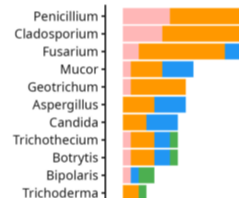
This study assessed the diversity of microscopic fungi in two areas of the Archaeological Museum Park of Tunja, (Universidad Pedagógica y Tecnológica de Colombia), aiming to anlyze their potential impact on human health and their capacity to cause biodeterioration of heritage materials. A total of 50 samples were collected from air, surfaces, bioanthropological remains, and ceramic objects. These samples were cultured on Sabouraud agar with chloramphenicol (0,05 g/L) and incubated at a temperature of 25 °C. Macroscopic and microscopic analyses identified 20 genera of fungi and yeasts, with Penicillium (26,9 %), Cladosporium (15,6 %), Fusarium (14,4 %), and Mucor (5,4 %) being the most prevalent. These genera have been reported in the literature for their association with both infectious processes and material degradation. The findings indicate a dual potential risk, sanitary and conservation-related, highlighting the need to implement monitoring and environmental control strategies to protect both public health and culture heritage.
Downloads
References
1. Pradilla, H.; Villate, G.; Ortiz, F., ‘Arqueología del cercado grande de los santuarios’, Boletín del Museo del Oro (1993) 21-147.
2. Argüello, P., Tunja Prehispánica, UPTC, Tunja (2023), https://doi.org/10.19053/9789586607940.
3. Mallo, A. C.; Elíades, L. A.; Nitiu, D. S.; Saparrat, M. C. N., ‘Fungal monitoring of the indoor air of the Museo de La Plata Herbarium, Argentina’, Revista Iberoamericana de Micología 34(2) (2017) 99-105, https://doi.org/10.1016/j.riam.2016.05.003.
4. Kour, D.; Khan, S. S.; Gusain, M.; Bassi, A.; Kaur, T.; Kataria, A.;Kaur, S.; Kour, H., ‘Airborne fungal communities: diversity, health impacts, and potential AI applications in aeromycology’, Aerobiology 3(4) (2025) 10, https://doi.org/10.3390/aerobiology3040010.
5. Fashola, M. O.; Ajilogba, C. F.; Aremu, B. R.; Babalola, O. O., ‘Airborne fungi and mycotoxins’, in Aeromicrobiology, Elsevier, London (2023) 147-175, https://doi.org/10.1016/C2021-0-01860-5.
6. Lu, Y.; Wang, X.; Almeida, L. C. S. D. S.; Pecoraro, L., ‘Environmental factors affecting diversity, structure, and temporal variation of airborne fungal communities in a research and teaching building of Tianjin University, China’, Journal of Fungi 8(5) (2022) 431, https://doi.org/10.3390/jof8050431.
7. Sterflinger, K., ‘Fungi: their role in deterioration of cultural heritage’, Fungal Biology Reviews 24(1-2) (2010) 47-55, https://doi.org/10.1016/j.fbr.2010.03.003.
8. Farro-Barbaran, R.; Ramos-Iturregui, W. M.; Iglesias-Osores, S.; Carreño-Farfán, C., ‘Aislamiento e identificación de microorganismos ambientales del museo Tumbas Reales de Sipán’, Revista UDCA Actualidad & Divulgación Científica 24(2) (2021) 1-11.
9. Mircea, C.; Vulpoi, A.; Rusu, I.; Radu, C.; Pârvu, M.; Kelemen, B., ‘Exploring post‐excavation degradation potential of fungal communities associated with archaeological human remains’, Archaeometry 61(3) (2019) 750-763, https://doi.org/10.1111/arcm.12438.
10. Koestler, R. J., ‘Biodeterioration in museum collections’, in Met Objectives, ed. D. Schorsch & M. Manuels, The Sherman Fairchild Center for Objects Conservation, New York (2002), https://repository.si.edu/items/d1e759f7-627d-4421-8d5d-ac09ff2cf1c6 (acceso en 2026-05-22).
11. Carrillo Chavez, L. M.; Arias Bermúdez, N.; Nieto Venegas, M. J.; Pinto Sanchez, N. R.; Patiño, M. C., ‘Study of biodeterioration and evaluation of proteolytic activity caused by microorganisms in specimens of a zoological collection in Colombia’, Conservar Património 45 (2023) 7-20, https://doi.org/10.14568/cp24895.
12. Kakakhel, M. A.; Wu, F.; Gu, J.-D.; Feng, H.; Shah, K.; Wang, W., ‘Controlling biodeterioration of cultural heritage objects with biocides: a review’, International Biodeterioration & Biodegradation 143 (2019) 104721, https://doi.org/10.1016/j.ibiod.2019.104721.
13. Urzì, C.; Leo, F. D., 'Biodeterioration of cultural heritage in Italy: state of art', in European Research on Cultural Heritage. State of Art Studies, vol. 2, ed. D. Milos, Academy of Sciences in The Czech Republic, Praga (2004) 465-471.
14. Pinheiro, A. C.; Sequeira, S. O.; Macedo, M. F., ‘Fungi in archives, libraries, and museums: a review on paper conservation and human health’, Critical Reviews in Microbiology 45(5-6) (2019) 686-700, https://doi.org/10.1080/1040841X.2019.1690420.
15. Wiszniewska, M.; Walusiak-Skorupa, J.; Gutarowska, B.; Krakowiak, A.; Pałczyński, C., ‘Is the risk of allergic hypersensitivity to fungi increased by indoor exposure to moulds?’, International Journal of Occupational Medicine and Environmental Health 22(4) (2009) 343-354, https://doi.org/10.2478/v10001-009-0030-7.
16. Scarlat, I.; Haiducu, M.; Stepa, R., ‘Air contamination with fungals in museum’, ACTA Universitatis Cibiniensis 66(1) (2015) 165-168, https://doi.org/10.1515/aucts-2015-0047.
17. Zielińska-Jankiewicz, K.; Kozajda, A.; Piotrowska, M.; Szadkowska-Stańczyk, I., 'Microbiological contamination with moulds in work environment in libraries and archive storage facilities', Annals of agricultural and environmental medicine 15(1) (2008)71-78.
18. Trovão, J.; Portugal, A.; Soares, F.; Paiva, D. S.; Mesquita, N.; Coelho, C.; Pinheiro, A. C.; Catarino, L.; Gil, F.; Tiago, I., ‘Fungal diversity and distribution across distinct biodeterioration phenomena in limestone walls of the old cathedral of Coimbra, UNESCO World Heritage Site’, International Biodeterioration & Biodegradation 142 (2019) 91-102, https://doi.org/10.1016/j.ibiod.2019.05.008.
19. Cepeda, R.; Luque, L.; Ramirez, D.; Franco, P.; Fabra, M., ‘Monitoreo de hongos ambientales en laboratorios y reservas patrimoniales bioarqueologicas’, Boletín Micológico 34(2) (2019) 33-49, https://doi.org/10.22370/bolmicol.2019.34.2.1909.
20. Micali, O.; Montacutelli, R.; Tarsitani, G., ‘Pathogenic microorganisms and situations of risk to man’, in Cultural heritage and aerobiology: methods and measurement techniques for biodeterioration monitoring, eds. P. Mandrioli, G. Caneva y C. Sabbioni, Springer, Dordrecht (2003) 31-43.
21. Guiamet, P.; Borrego, S.; Lavin, P.; Perdomo, I.; de Saravia, S. G., ‘Biofouling and biodeterioration in materials stored at the Historical Archive of the Museum of La Plata, Argentine and at the National Archive of the Republic of Cuba’, Colloids and Surfaces B: Biointerfaces 85(2) (2011) 229-234, https://doi.org/10.1016/j.colsurfb.2011.02.031.
22. Pérez, H.; Sánchez, V. L., ‘Propuesta de diseño de monitoreo ambiental microbiológico para diagnóstico de niveles de contaminación en áreas de procesamiento aséptico’, ICIDCA. Sobre los Derivados de la Caña de Azúcar 44(3) (2010) 7-14.
23. López-Aranda. B. G., ‘Caracterización microbiológica de los almacenes del museo Tumbas Reales de Sipán en Lambayeque, Perú’, La zaranda de ideas 18(2) (2020) 136-145.
24. Bogomolova, E.; Kirtsideli, I., ‘Airborne fungi in four stations of the St. Petersburg Underground railway system’, International Biodeterioration & Biodegradation 63(2) (2009) 156-160, https://doi.org/10.1016/j.ibiod.2008.05.008.
25. Larone, D. H., Medically important fungi: a guide to identification, 2ª ed., American Society for Microbiology, Washington, D.C (1993)
26. de Hoog, G.; Guarro, J.; Gené, J.; Figueras, M. J., Atlas of clinical fungi, CABI Digital Library (2000), https://www.cabidigitallibrary.org/doi/full/10.5555/20013005530.
27. Carvalho, H. L. da S. P., Biodeterioration in cultural assets: fungal contamination assessment in art objects and documents, tesis doctoral, Departamento de Ciencias da Vida, Universidade de Coimbra, Coimbra (2018).
28. R Core Team, R: A Language and environment for statistical computing, R Foundation for Statistical Computing, Vienna (2023), https://www.R-project.org/ (acceso en 2026-05-22).
29. Oksanen, J; Simpson, G. L.; Guillaume Blanchet, F.; Kindt, R.; Legendre, P.; Minchin, p. R.; O’Hara, R. B.; Solymos, P.; Stevens, M. H. H.; Szoecs, E.; Wagner, H.;. et al., ‘Ordination methods, diversity analysis and other functions for community and vegetation ecologists’, in vegan: Community Ecology Package (2004), https://CRAN.R-project.org/package=vegan (acceso en 2026-05-22).
30. Magurran, A. E., Measuring Biological Diversity, Blackwell Publishing, Oxford (2004).
31. García, J. C. R., ‘Microbiología aplicada: una herramienta parala conservación del Patrimonio Cultural’, Conservar Património 24 (2016) 23-36, https://doi.org/10.14568/cp2015007.
32. Toyoda, A.; Shibata, Y.; Matsuo, Y.; Terada, K.; Sugimoto, H.; Higashi, K.; Mori, H.; Ikeuchi, A.;Ito, M.; Kurokawa, K.; Katahira, S., ‘Diversity and compositional differences of the airborne microbiome in a biophilic indoor environment’, Scientific Reports 13(1) (2023) 8179, https://doi.org/10.1038/s41598-023-34928-9.
33. Adams, R. I.; Miletto, M.; Taylor, J. W.; Bruns, T. D., ‘The diversity and distribution of fungi on residential surfaces’, PLoS ONE 8(11) (2013) e78866, https://doi.org/10.1371/journal.pone.0078866.
34. Méndez-Puentes, C. A.; Camacho-Suárez, J. G.; Echeverry-Hernández, S., ‘Identification of bacteria and fungi in the air of Neiva, Colombia’, Revista de Salud Pública 17(5) (2015) 728-737, https://doi.org/10.15446/rsap.v17n5.38468.
35. Zaragoza, O., Los hongos microscópicos, ¿Amigos o enemigos?, Instituto de Salud Carlos III (ISCIII), Centro Nacional de Microbiología (CNM), Madrid (2018), https://repisalud.isciii.es/handle/20.500.12105/11824.
36. Arenas Guzmán, R., Micología médica ilustrada, 6ª ed., McGraw-Hill Interamericana, Ciudad de México (2019).
37. Bonifaz Trujillo, J. A., Micología médica básica, 6ª ed., McGraw Hill, Ciudad de México (2020).
38. Senthilkumar, M.; Anandham, R.; Krishnamoorthy, R., ‘Paecilomyces’, in Beneficial microbes in agro-ecology, eds. N. Amaresan, M. S. Kumar, K. Annapurna, K. Kumar & A. Sankaranarayanan, Elsevier, London (2020) 793-808, https://doi.org/10.1016/B978-0-12-823414-3.00041-1.
Downloads
Published
How to Cite
Issue
Section
Categories
License
This work is distributed under a Creative Commons Attribution License (CC BY-NC-ND 4.0) which permits use, distribution, and reproduction in any medium following no commercial or derivatives, provided the original author and source are credited.
Copyright remains with the authors.