Applicability of X-ray imaging to monitor the internal condition of waterlogged archaeological wood – pre-, intra-, and post-conservation
DOI:
https://doi.org/10.14568/cp39271Keywords:
Waterlogged archaeological wood, Conservation, Condition, X-rayAbstract
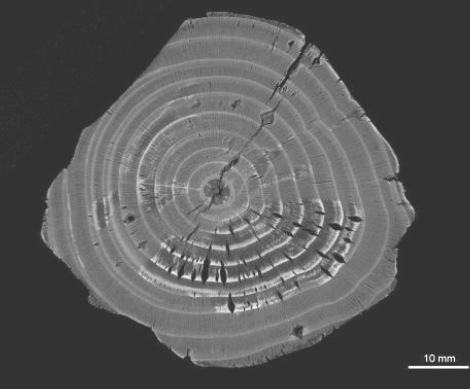
During conservation treatment, the greatest threat to waterlogged archaeological wooden (WAW) objects is collapse and/or shrinkage, which can occur during the drying process. Recent work undertaken by the CuTAWAY project revealed, using Micro-computed tomography (micro-CT), that the extent of adverse structural changes found internally in conserved WAW was far greater than generally anticipated. Suggesting a need for conservators to be able to monitor and assess the internal condition of WAW, prior to, during and after treatment. In this study, it was found that X-ray imaging offers a faster and more widely available alternative to micro-CT scanning. While the images are lower resolution than their micro-CT counterparts, they were able to make out the vast majority of internal damages present in a range of samples during various stages of treatment. However, the correct interpretation of internal damage in the X-ray images requires an underlying knowledge of the wood material.
Downloads
References
1. Kaye, B., ‘Conservation of waterlogged archaeological wood’, Chemical Society Reviews 24(1) (1995) 35-43, https://doi.org/10.1039/CS9952400035.
2. Historic England, Waterlogged wood: guidelines on the recording, sampling, conservation and curation of waterlogged wood, Historic England Publications, Swindon (2010), https://historicengland.org.uk/images-books/publications/waterlogged-wood/ (accessed 2024-10-30).
3. Pedersen, N. B., Microscopic and spectroscopic characterisation of waterlogged archaeological softwood from anoxic environments, University of Copenhagen, Frederiksberg (2015).
4. Singh, A, P., ‘A review of microbial decay types found in wooden objects of cultural heritage recovered from buried and waterlogged environments’, Journal of Cultural Heritage 13(3) (2012) 16-20, https://doi.org/10.1016/j.culher.2012.04.002.
5. Haque, N., ‘Delamination in timber induced by drying’, in Delamination in Wood, wood products and wood-based composites, ed. V. Bucur, Springer Netherlands, Dordrecht (2011) 197-212, https://doi.org/10.1007/978-90-481-9550-3_10.
6. Fu, Z.; Jiaxing, C.; Yongyue, Z.; Feifan, X.; Yun, L. ‘Review on wood deformation and cracking during moisture loss’, Polymers 15(15) (2023) 3295, https://doi.org/10.3390/polym15153295.
7. Grattan, D. W.; Clarke, R. W., ‘Conservation of waterlogged wood’, in Conservation of marine archaeological objects, ed. C. Pearson, Butterworths, London (1987) 164-206, https://doi.org/10.1016/B978-0-408-10668-9.50015-0.
8. Jensen, P., ‘Sorption of water and water soluble agents in the waterlogged wooden cell wall’, in Proceedings of the 6th ICOM Group on wet organic archaeological materials conference, eds. P. Hoffmann, T. Daly, T. Grant & J. Spriggs, Druckerei Ditzen GmbH und Co., Bremerhaven (1997) 399-434.
9. Strætkvern, S., ‘Vacuum freeze-drying of waterlogged archaeological wood and selecting the impregnation agent prior to drying’, in Proceedings of the international experts’ meeting on the extraction and conservation of the Wreck Mazarrón 2, eds. M. A. Garcia, R. C. Belinchon & C. C. Escribano, Ministerio de Cultura, Madrid (2023) 303-314.
10. Johns, D. A., ‘Post-excavation treatment methods for waterlogged organic archaeological materials: the last twenty years’, in The Oxford handbook of wetland archaeology, eds. F. Menotti & A. O'Sullivan, Oxford Academic, Oxford (2012) 664-684, https://doi.org/10.1093/oxfordhb/9780199573493.013.0040.
11. Stelzner, I.; Stelzner, J.; Martinez-Garcia, J.; Gwerder, D.; Wittköpper, M.; Muskalla, W.; Cramer, A.; Heinz, G.; Egg, M.; Schuetz, P., ‘Evaluation of conservation methods for archaeological wet wood with structured light 3D scanning and µ-CT’, in Proceedings of the 15th ICOM-CC Group on wet organic archaeological materials conference, eds. I. Hovmand, M. Felter & I. Stelzner, ICOM-CC, Mainz (2023) 96-105.
12. Mardikian, P.; Chemello, C., ‘Conservation laboratory design’, in Encyclopedia of global archaeology, ed. C. Smith, Springer, Cham (2018) 1-7, https://doi.org/10.1007/978-3-319-51726-1_433-2.
13. Evans, P. D., ‘The effects of incising on the checking of wood: a review’, International Wood Products Journal 7(1) (2016) 12-25, https://doi.org/10.1080/20426445.2015.1112936.
14. Yang, D-Q.; Normand, D., Best practices to avoid hardwood checking Part I. Hardwood checking – the causes and prevention, FPInnovations - Transorfmative Technologies Program, Quebec (2012).
15. Pearson, H.; Donaldson, L.; Kimberley, M.; Davy, B., ‘Supercritical CO2 drying of New Zealand Red Beech to below the fibre saturation point reduces collapse distortion’, Wood Science and Technology 58(2) (2024) 459-483, https://doi.org/10.1007/s00226-023-01509-y.
16. Richter, C., ‘Overview of cracks/shake forms and causes’, in Wood characteristics: description, causes, prevention, impact on use and technological adaptation, ed. C. Richter, Springer International Publishing, Cham (2015) 199-208, https://doi.org/10.1007/978-3-319-07422-1_8.
17. Putoczki, T. L.; Nair, H.; Butterfield, B.; Jackson, S. L., ‘Intra-ring checking in Pinus Radiata D. Don: the occurrence of cell wall fracture, cell collapse, and lignin distribution’, Trees 21(2) (2007) 221-229, https://doi.org/10.1007/s00468-006-0114-y.
18. Grattan, D. W., ‘Waterlogged wood’, in Conservation of marine archaeological objects, ed. C. Pearson, Butterworths, London (1987) 55-67, https://doi.org/10.1016/B978-0-408-10668-9.50009-5.
19. ‘Mass Finds in Archaeological Collections’, in RGZM, https://www1.rgzm.de/kur/ (accessed 2024-03-13).
20. Bond, J.; Donaldson, L.; Hill, S.; Hitchcock, K., ‘Safranine fluorescent staining of wood cell walls’, Biotechnic & Histochemistry 83(3-4) (2008) 161-171, https://doi.org/10.1080/10520290802373354.
21. Wheeler, E.; Baas, P.; Gasson, P., ‘IAWA list of microscopic features for hardwood identification’, IAWA Bulletin 10(3) (1989) 219-332.
22. Richter, H. G.; Grosser, D.; Heinz, I.; Peter, E., ‘IAWA list of microscopic features for softwood identification’, IAWA journal 25(1) (2004) 1-70.
23. Jensen, P.; Gregory, D. J., ‘Selected physical parameters to characterize the state of preservation of waterlogged archaeological wood: a practical guide for their determination’, Journal of Archaeological Science 33(4) (2006) 551-559, https://doi.org/10.1016/j.jas.2005.09.007.
24. Sluiter, A.; Hames, B.; Ruiz, R.; Scarlata, C.; Sluiter, J.; Templeton, D., ‘Determination of ash in biomass (NREL/TP-510-42622)’, in National Renewable Energy Laboratory Technical Report 19, National Renewable Energy Laboratory, Golden Colorado (2005).
25. Feldkamp, L. A.; Davis, L. C.; Kress, J. W., ‘Practical cone-beam algorithm’, Journal of the Optical Society of America A1 (1984) 612-619.
26. Niemz, P.; Sonderegger, W.; Keplinger, T.; Jiang, J.; Lu, J., ‘Physical properties of wood and wood-based materials’, in Springer handbook of wood science and technology, eds. P. Niemz, A. Teischinger & D. Sanberg, Springer International Publishing, Cham (2023) 281-353.
27. de Jong, J., ‘Conservation techniques for old archaeological wood from shipwrecks found in the Netherlands’, in Biodeterioration investigation techniques, ed. A. H. Walters, Applied Science, London (1977) 295-338.
28. Hedges, J. I., ‘The chemistry of archaeological wood’, in Archaeological wood. properties, chemistry and preservation, eds. R. M. Rowell & R. J. Barbour, American Chemical Society, Washington D. C. (1990) 111-139.
29. Passialis, C. N., ‘Physico-chemical characteristics of waterlogged archaeological wood’, Wood Research and Technology 51(2) (1997) 111-113, https://doi.org/10.1515/hfsg.1997.51.2.111.
30. McConnachie, G.; Eaton, R.; Jones, M., ‘A re-evaluation of the use of maximum moisture content data for assessing the condition of waterlogged archaeological wood’, E-preservation Science 5 (2008) 29-35.
31. Gryc, V.; Vavrčík, H.; Horn, K., ‘Density of juvenile and mature wood of selected coniferous species’, Journal of Forest Science 57(3) (2011) 123-130, https://doi.org/10.17221/18/2010-JFS.
32. Withers, P. J.; Bouman, C.; Carmignato, S.; Cnudde, V.; Grimaldi, D.; Hagen, C. K.; Maire, E.; Manley, M.; Du Plessis, A.; Stock, S.R., ‘X-ray computed tomography’, Nature Reviews Methods Primers 1 (2021) 18, https://doi.org/10.1038/s43586-021-00015-4.
33. Almkvist, G.; Persson, I.,‘Extraction of iron compounds from wood from the Vasa’, Holzforschung 60(6) (2006) 678-684, https://doi.org/10.1515/HF.2006.114.
Downloads
Published
How to Cite
Issue
Section
Categories
License
This work is distributed under a Creative Commons Attribution License (CC BY-NC-ND 4.0) which permits use, distribution, and reproduction in any medium following no commercial or derivatives, provided the original author and source are credited.
Copyright remains with the authors.