Combinação de abordagens históricas e experimentais para uma melhor compreensão da cor preta do pergaminho do manuscrito da Basse Danse de Margarida da Áustria (KBR ms. 9085)
DOI:
https://doi.org/10.14568/cp43802Palavras-chave:
Pergaminho preto, Tingimento, Receitas históricas, Reconstrução, Tinta ferrogálica, Manuscrito medievalResumo
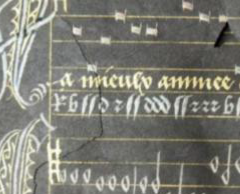
O manuscrito da Basse Danse de Margarida da Áustria é uma das fontes mais antigas sobre dança e música nos Países Baixos medievais. Possui ainda uma característica rara: está escrito com tinta dourada e prateada sobre pergaminho preto. Carecemos de informações sobre o processo de tingimento do pergaminho, em particular no que diz respeito à produção de pergaminho preto. No entanto, este conhecimento é essencial para compreender o seu estado atual e para planear melhor a sua conservação. O manuscrito apresenta danos extensos, provavelmente devido à natureza ferrogálica do corante preto: o pergaminho, que é muito frágil, apresenta ruturas e perdas, que foram alvo de um restauro anterior inadequado, resultando numa maior deterioração. Ao examinar textos técnicos históricos (receitas para o tingimento e para a fabricação de tintas) e realizar experiências de tingimento em pergaminho moderno, pretendemos obter uma visão sobre as possíveis técnicas utilizadas para criar este notável manuscrito.
Downloads
Referências
1. Reiffenberg, F. A. F. T. baron de, Notices et extraits des manuscrits de la Bibliothèque dite de Bourgogne, relatifs aux Pays-Bas. Tome premier, première partie., Hayez, Brussels (1829).
2. McDonald, G., ‘Introduction’, in Margaret of Austria’s Basse Danse manuscript – Het Basse Danse-handschrift van Margaretha van Oostenrijk, ed. G. McDonald, Facsimile vol.6, Leuven Library of Music, Alamire Foundation and Davidsfonds Uitgave, Leuven (2022) 11-15.
3. Eichberger, D., ‘The Court of Savoy in Mechelen: musical manuscripts in the Library of Margaret of Austria’, in Margaret of Austria’s Basse Danse manuscript – Het Basse Danse-handschrift van Margaretha van Oostenrijk, ed. G. McDonald, Facsimile vol.6, Leuven Library of Music, Alamire Foundation and Davidsfonds Uitgave, Leuven (2023) 125-140.
4. McDonald, G., ‘The Brussels Basse Danse manuscript in context’, in Margaret of Austria’s Basse Danse manuscript – Het Basse Danse-handschrift van Margaretha van Oostenrijk, ed. G. McDonald, Facsimile vol.6, Leuven Library of Music, Alamire Foundation and Davidsfonds Uitgave, Leuven (2023) 89-124.
5. Pastoureau, M., Noir. Histoire d’une couleur, Points (collection Histoire), Paris (2008).
6. Hohti, P., ‘Power, black clothing, and the chromatic politics of textiles in renaissance Europe’, in Burgundian black: reworking early modern colour technologies, eds. J. Boulboullé & S. Dupré, EMC Imprint, Santa Barbara (2022), https://doi.org/10.55239/bb001.
7. Jolivet S., ‘The construction of an image: Philip the Good in Black (1419-1467)’, in Burgundian black: reworking early modern colour technologies, eds. J. Boulboullé, S. Dupré, EMC Imprint, Santa Barbara (2022), https://doi.org/10.55239/bb001.
8. Lemaire C., ‘Les Basses Danses de Marguerite d’Autriche’, in Das Tanzbüchlein der Margarete von Österreich, Kommentarband. Akademische Druck- und Verlagsanstalt, Graz (1987-1988) 13-23.
9. Vnoucek, J.; Fiddymetn S.; Quandt, A.; Rabitsch S.; Collins, M.; Hofmann, C., ‘The parchment of the Vienne Genesis: characteristics and manufacture’, in The Vienna Genesis. Material analysis and conservation of a Late Antique illuminated manuscript on purple parchment, ed. C. Hofmann, Böhlau Verlag, Wien Köln Weimar (2020) 35-69.
10. Hofmann, C.; Gersten, T., ‘The conservation of black manuscripts: an open question’, in Margaret of Austria’s Basse Danse manuscript – Het Basse Danse-handschrift van Margaretha van Oostenrijk, ed. G. McDonald, Facsimile vol.6, Leuven Library of Music, Alamire Foundation and Davidsfonds Uitgave, Leuven (2023) 141-153.
11. Unpublished analysis report n° DI 84/2948 – 21/32. – A 1176, KIK-IRPA, Brussels (1984).
12. Reissland, B., ‘Black colour technologies for Burgundian illuminators’, in Burgundian black: reworking early modern colour technologies, eds. J. Boulboullé, S. Dupré, EMC Imprint, Santa Barbara (2022), https://doi.org/10.55239/bb001.
13. Hofenk de Graaff, J., The colourful past. Origins, chemistry and identification of natural dyestuffs, Abegg-Stiftung/Archetype publications, Switzerland/London (2004).
14. Cordoba de la Llave, R., ‘Textes techniques médiévaux sur le tannage et la teinture du cuir’, in Le travail du cuir de la préhistoire à nos jours, XXIIe rencontres internationales d’archéologie et d’histoire d’Antibes, dir. F. Audoin-Rouzeau, S Beyries, Editions APDCA, Antibes (2002) 351-365.
15. Rosetti, G., The Plictho. Instruction in the art of the dyers which teaches the dyeing of woolen cloths, linnens, cottons, and silk by the great art as well as by the common, Trans. S. M. Edelstein & H. C. Borghetty, The M.I.T. Press, Cambridge Massachusetts and London England (1969).
16. ‘Manuscripts of Bologna’, in Medieval and Renaissance treatises on the arts of painting. Original texts with English translations, ed. M.P. Merrifield, Dover publications, Mineola [N.Y.] (1999), originally published 1849, 325-340.
17. T bouck van wondre, 1513. ed H.G.Th. Frencken, Drukkerij H. Timmermans, Roermond (1934).
18. ‘Manuscripts of Jehan le Bègue’, in Medieval and Renaissance treatises on the arts of painting. Original texts with English translations, ed. M.P. Merrifield, Dover publications, Mineola [N.Y.] (1999), originally published 1849, 1-111.
19. Les secrets du S. Alexis Piemontois, divisez en six livres: ausquels auons adjoint autres secrets de nouveaus adjoutez par iceluy, qu’aucuns ont appellé, le Second Volum: & Les receptes de divers auteurs toutes biens experimentées, & apporuuées, Imprimerie de Christophe Plantin, Anvers (1559).
20. Bastiment des receptes, contenant trois petites parties de receptaires. La premiere, tracte de diverses vertus & proprietez des choses. La seconde est, de diverses sortes dodeurs & compositions dicelles. La tierce, comprend aucun secrets medicinaulx,… Plusieurs choses ont este adioustees oultre les precedantes impressions & declataions [...] motz que cest, Iacques Bouchet, Poitiers (1544).
21. Albo, J., Instruction générale pour la teinture des laines et manufactures de laine de toutes couleurs, et pour la culture des drogues ou ingrédients qu'on y emploie, Imprimerie de François Muguet, Paris (1671).
22. Le teinturier parfait, ou l'art de teindre les soyes, laines, fils, chapeurs & c. La manière de mettre en couleur les Cuirs, l'Yvoire, les Os, le Bois, le Verre, le Cristal, &c., chez Claude Jombert, Paris (1716).
23. Braekman, W. L., Medische en technische Middelnederlandse recepten: Een tweede bijdrage tot de geschiedenis van de vakliteratuur in de Nederlanden, Secretariaat van de Koninklijke Academie voor Nederlandse Taal- en Letterkunde, Gent (1975).
24. Neven, S., The Strasbourg manuscript. A medieval tradition of artists recipe collections (1400-1570), Archetype Publication, London (2016).
25. Zerdoun Bat-Yehouda, M., Les encres noires au Moyen-Age, Annexe 1 Les recettes, CNRS, Paris (1983).
26. Cennini, C., Il libro dell'arte, trans.C. Déroche, Editions Berger-Levrault, Paris (1991).
27. Reed R., Ancient skins, parchments and leathers, Seminar Press, London/New York (1972).
28. Kolar, J.; Strlic, M. (eds.), Iron gall inks: on manufacture, characterisation, degradation and stabilization, National and University Library, Ljubljana (2006).
29. Hofenk de Graaff, J., ‘Dyeing black in seventeenth-century Holland’, in Conserving textiles. Studies in honour of Ágnes Timár-Balászy, ed. Éri I., ICCROM, Rome (2009) 60-67.
30. Stijnman, A., ‘Iron gall inks in history: ingredients and production’, in Iron gall inks: on manufacture, characterisation, degradation and stabilisation, eds. J. Kolar & M. Strlic, National and University Library, Ljubljana (2006) 25-68.
31. Kirby, J.; van Bommel, M.; Verhecken, A., Natural colorants for dyeing and lake pigments. Practical recipes and their historical sources, Archetype Publications, London (2014).
32. Porter, C., ‘The colouring of alum-tawed skins on late Medieval books’, in Dyes in History and Archaeology 16/17, Papers presented at the 16th meeting Lyons, 1997 and the 17th Meeting Greenwich, ed. J. Kirby, Archetype Publications, London (1998) 199-203.
33. Chahine, C., Cuir et parchemin ou la métamorphose de la peau, CNRS éditions, Paris (2013).
34. Boulboullé, J.; Dupré, S., ‘How site matters to reworking with makers’, in Burgundian black: reworking early modern colour technologies, eds. J. Boulboullé & S. Dupré, EMC Imprint, Santa Barbara (2022), https://doi.org/10.55239/bb001.
35. Rabitsch, S.; Boesken Kanold, I.; Hofmann, C., ‘Purple dyeing of parchment’, in The Vienna Genesis. Material analysis and conservation of a Late Antique illuminated manuscript on purple parchment, ed. C. Hofmann, Böhlau Verlag, Wien Köln Weimar (2020) 71-101.
Downloads
Publicado
Como Citar
Licença
O presente trabalho é distribuído nos termos da Licença Creative Commons (CC BY-NC 4.0) que permite a utilização, partilha e reprodução para fins não comerciais e sem modificações, desde que o autor e fonte original sejam citados.
O Copyright permanece com os autores.