Balancing artist’s intent and durability: conserving a corroded outdoor painted iron sculpture
DOI:
https://doi.org/10.14568/cp43014Keywords:
Outdoor sculpture conservation, Painted metal, Repainting, Polyurethane paint system, Artist's intent, Minimal interventionAbstract
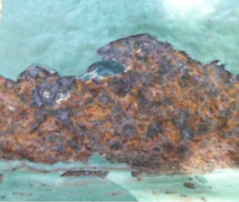
Conserving outdoor painted sculptures (OPSs) is challenging due to their constant exposure to uncontrolled environments. This paper outlines the methodology employed to conserve the Tree, a large-scale monochrome iron sculpture by George Lappas which has been situated in a coastal environment for decades. The artwork had suffered extensive metal corrosion and paint deterioration. Following an ethical evaluation of the artist's intentions versus the need for long-term stability, it was deemed necessary to repaint the sculpture completely. A comprehensive diagnostic approach was taken, including XRF, XRD, SEM-EDX, colourimetry and gloss measurement, as well as investigative cleaning. The study addresses the challenges of removing multiple paint layers and addressing various corrosion issues. The final conservation treatment involved using epoxy resin to fill in losses and a durable polyurethane paint system. Combining traditional and modern techniques restored the sculpture’s original aesthetic qualities, while maximising its resistance to aggressive environmental conditions.
Downloads
References
1. Lowinger, R.; Mack, A.; Moody, E.; Perugini, F.; Rivenc, R.; Golfomitsou, S., ‘Making it last: training conservators in sustainable solutions for treating outdoor painted sculpture’, Studies in Conservation 69(sup1) (2024) 208-217, https://doi.org/10.1080/00393630.2024.2336794.
2. Beerkens, L; Learner, T, Conserving outdoor painted sculpture, Proceedings from the interim meeting of the modern materials and contemporary art working group of ICOM-CC Krφller-Mόller Museum, eds. L. Beerkens & T. Learner, Otterlo, The Netherlands (2013).
3. Learner T.; Rivenc, R., ‘Conserving outdoor painted sculpture: outcomes from a focus meeting’, in Conserving outdoor painted sculpture, Proceedings from the interim meeting of the modern materials and contemporary art working group of ICOM-CC Kröller-Müller Museum, eds. L. Beerkens & T. Learner, Otterlo, The Netherlands, (2013) 13-22.
4. Learner T.; Rivenc, R., The conservation of twentieth-century outdoor painted sculpture meeting report, The Metropolitan Museum of Art, New York (2015).
5. Oh, S.-J.; Wi, K.-C., ‘A basic research for preservation of works exhibited in the outdoor sculpture park - a scientific analysis of painted work “conversion” exhibited in the Cheonmasan sculpture park’, Journal of Conservation Science 37(4) (2021) 391-401, https://doi.org/10.12654/jcs.2021.37.4.08.
6. Molina, M. T.; Cano, E; Ramírez-Barat, B., ‘Protective coatings for metallic heritage conservation: a review’, Journal of Cultural Heritage 62 (2023) 99-113, https://doi.org/10.1016/j.culher.2023.05.019.
7. Pullen, D.; Heuman, J., ‘Modern and contemporary outdoor sculpture conservation challenges and advances’, The Getty Conservation Institute Newsletter 22(2) (2007) 4-10.
8. Mack, A.; Sturman, S.; Escarsega, J. A., ‘Adapting military camouflage paint for matte outdoor sculpture’, in Modern paints uncovered: proceedings from the modern paints uncovered symposium, eds. T.J.S. Learner, P. Smithen, J. W. Krueger & M. R. Schilling, Getty Conservation Institute, Los Angeles (2007) 66-74.
9. Beerkens, L.; van Basten, N.; Learner, T., ‘Saving the colors. Decision making in the conservation of outdoor painted sculptures’, in CESMAR7 Conference, Colour and Conservation, Il Prato publications, Milano (2015) 150-156.
10. Wharton, G., ‘The challenges of conserving contemporary art’, in Collecting the new: museums and contemporary art, ed. B. Altshuler, Princeton University Press, Princeton (2007) 163-178.
11. Clare, T. L.; Swartz, N. A., ‘Chapter 19 - Characterization of high-performance protective coatings for use on culturally significant works’, in Intelligent coatings for corrosion control, eds. A. Tiwari, J. Rawlins, L. H. Hihara, Butterworth-Heinemann, Amsterdam (2015) 641-671, https://doi.org/10.1016/B978-0-12-411467-8.00019-2.
12. Benson, P., ‘Some considerations in determining new paint systems for use in the treatment of painted fiberglass and steel outdoor sculptures’, in Conserving outdoor painted sculpture, Proceedings from the interim meeting of the modern materials and contemporary art working Group of ICOM-CC Kröller-Müller Museum, eds. L. Beerkens & T. Learner, Otterlo, The Netherlands (2013) 87-94.
13. Langenbacher, J.; Rivenc, R.; Flavin, A., Documenting painted surfaces for outdoor painted sculptures: a manual of laboratory and field test methods, Getty Conservation Institute, Los Angeles (2017), http://hdl.handle.net/10020/gci_pubs/documenting_painted.
14. Defeyt, C.; Langenbacher, J.; Rivenc, R., ‘Polyurethane coatings used in twentieth century outdoor painted sculptures. Part I: comparative study of various systems by means of ATR-FTIR spectroscopy’, Heritage Science 5(1) (2017) 11, https://doi.org/10.1186/s40494-017-0124-7.
15. Spinari-Pollalis, Τ.; Liti, Α.; Tzirtzilakis, G., George Lappas. Encapsulation - Mappemonde - The Secret Book, Catalogue exhibition, Kastaniotis publishing, Athens (2018).
16. Lappas, G., George Lappas - Mappemonde, Biennale of Venice, Aperto (1988).
17. ‘Climate and Weather in Greece: A Traveler's Guide’, in Hikersbay (2025), https://hikersbay.com/climate/greece (accessed 2025-07-13).
18. Alcántara, J.; Fuente, D. d. l.; Chico, B.; Simancas, J.; Díaz, I.; Morcillo, M., ‘Marine atmospheric corrosion of carbon steel: a review’, Materials 10(4) (2017) 406, https://doi.org/10.3390/ma10040406.
19. Tasker, J., ‘Austenitic steels: non-stainless’, in Encyclopedia of materials: science and technology, 2nd ed., Elsevier, Oxforf (2001) 411-415.
20. Webb, M., ‘Methods and materials for filling losses on lacquer objects’, Journal of the American Institute for Conservation 37(1) (1998) 117-133, https://doi.org/10.2307/3179915.
21. Neuman, I.; Martin, J., ‘Where east meets west: the conservation of a modern, large-scale, black lacquer sculpture exhibited in a public’, in Objects specialty group postprints, vol. 4, eds. V. Greene & J. Griswold, AIC, Norfolk (1996) 42-61.
22. Beerkens, L., ‘Side by side: old and new standards in the conservation of modern art. A comparative study on 20 years of modern art conservation practice’, Studies in Conservation 61(sup2) (2016) 12-16, https://doi.org/10.1080/00393630.2016.1155336.
23. van Basten, N.; Langenbacher, J.; Defeyt, C.; Rivenc, R., ‘Local treatment for monochrome outdoor painted metal sculptures: assessing the suitability of conservation paints for retouching’, in Conservation of sculpture parks conference; Spark - Conservation of Sculpture Parks, Sisak (2018) 143-154.
24. Nagy, E. E.; Lippincott, A.; Lippincott, D.; Chasse, J.; Prosser, R., ‘The treatment of a large painted outdoor sculpture: Kiosque l’évidé (1970) 1984, by Jean Dubuffet’, Journal of the American Institute for Conservation 62(1) (2022) 28-57, https://doi.org/10.1080/01971360.2022.2031456.
Downloads
Published
How to Cite
Issue
Section
Categories
License
This work is distributed under a Creative Commons Attribution License (CC BY-NC-ND 4.0) which permits use, distribution, and reproduction in any medium following no commercial or derivatives, provided the original author and source are credited.
Copyright remains with the authors.