Linternauta e a normalização da catalogação técnica das placas de lanterna mágica em Portugal
DOI:
https://doi.org/10.14568/cp42974Palavras-chave:
Lanterna mágica, Catalogação técnica, Normalização terminológica, Património audiovisual, Documentação patrimonial, Humanidades digitaisResumo
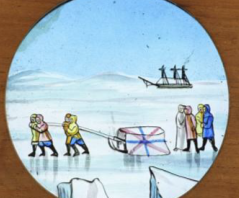
Este artigo analisa a atualização da plataforma digital Linternauta através da catalogação técnica de 427 placas de lanterna mágica preservadas em três instituições públicas portuguesas. O estudo aborda a instabilidade terminológica existente na descrição das técnicas de produção destas peças e propõe um modelo operativo de normalização baseado em quatro categorias: pictórica, impressa, fotográfica e mista. A classificação fundamenta-se na observação macroscópica, em fontes históricas e em estudos materiais recentes. Os resultados revelam um predomínio significativo de configurações técnicas híbridas no conjunto analisado, em consonância com investigações anteriores sobre coleções portuguesas. A normalização terminológica facilita a comparação interinstitucional, favorece o acesso digital estruturado e contribui indiretamente para estratégias de conservação preventiva ao reduzir potencialmente a manipulação direta de materiais frágeis. O caso português evidencia o potencial metodológico da catalogação técnica para a documentação patrimonial e as humanidades digitais.
Downloads
Referências
1. Barnes, J., ‘Classification of magic lantern slides for cataloguing and documentation’, in Magic images: the art of hand-painted and photographic lantern slides, eds. D. Crompton, D. Henry y S. Herbert, The Magic Lantern Society of Great Britain, London (1990) 75-84.
2. Mannoni, L., Le grand art de la lumière et de l’ombre: archéologie du cinéma, Nathan Université, Paris (1994).
3. Campagnoni, D. P., ‘História da lanterna magalográphica vulgarmente dita lanterna mágica’, in A magia da imagem: a arqueologia do cinema através das coleções do Museu Nacional de Turim, eds. P. Bertetto y D. P. Campagnoni, Centro Cultural de Belém, Lisboa (1996) 59-89.
4. Robinson, D.; Herbert, S.; Crangle, R. (eds.), Encyclopaedia of the magic lantern, Magic Lantern Society, London (2001).
5. Heard, M., ‘Now you see it, now you don’t: the magician and the magic lantern’, in Realms of light: uses and perceptions of the magic lantern from the 17th to the 21st century, eds. R. Crangle, M. Heard y I. van Dooren, Magic Lantern Society, London (2005) 13-24.
6. Heard, M., ‘The lantern is not dead: lantern and slides in the 20th century and beyond’, in Realms of light: uses and perceptions of the magic lantern from the 17th to the 21st century, eds. R. Crangle, M. Heard y I. van Dooren, Magic Lantern Society, London (2005) 193-194.
7. Crangle, R., Realms of light: uses and perceptions of the magic lantern from the 17th to the 21st century, Magic Lantern Society, London (2009).
8. Frutos, F. J., Los ecos de una lámpara maravillosa: la linterna mágica en su contexto mediático, Ediciones Universidad de Salamanca, Salamanca (2010).
9. Frutos, F. J., ‘From luminous pictures to transparent photographs: the evolution of techniques for making magic lantern slides’, The Magic Lantern Gazette 25(3) (2013) 3-11.
10. Huhtamo, E., Illusions in motion: media archaeology of the moving panorama and related spectacles, MIT Press, Cambridge (2013).
11. Dellmann, S., ‘Beyond and with the object: assessing the dissemination range of lantern slides and their imagery’, Early Popular Visual Culture 14(4) (2016) 340-358, https://doi.org/10.1080/17460654.2016.1222927.
12. Kember, J., ‘The magic lantern: open medium’, Early Popular Visual Culture 17(1) (2019) 1-8, https://doi.org/10.1080/17460654.2019.1640605.
13. López San Segundo, C.; Frutos, F. J.; Therón, R., ‘Linternauta: a web application for the interpretation of magic lantern slides according to discursive genre’, Early Popular Visual Culture 17(3-4) (2019) 361-385, https://doi.org/10.1080/17460654.2019.1705650.
14. Santos, Â.; Rodrigues, B.; Otero, V.; Vilarigues, M., ‘Defining the first preventive conservation guidelines for hand-painted magic lantern glass slides’, Conservar Património 37 (2021) 100-115, https://doi.org/10.14568/cp2020033.
15. Santos, Â.; Otero, V.; Vilarigues, M., ‘Production of hand-painted magic lantern glass slides: a literature review’, Studies in Conservation 68 (2023) 137-151, https://doi.org/10.1080/00393630.2023.2194080.
16. Santos, Â., Lanterna Magica – Technology and preservation of painted glass slides for projection with magic lanterns, Universidade Nova de Lisboa, Lisboa (2024), http://hdl.handle.net/10362/171450 (acesso en 2026-05-09).
17. ‘A million pictures: magic lantern slide heritage as artefacts in the common European history of learning’, A Million Pictures Project, Utrecht University (2018), https://a-million-pictures.wp.hum.uu.nl (acesso en 2026-05-09).
18. MAGICA Project, MAGICA – Magic Lantern: Study, Safeguard, Uses and Reuse in 19th-Century Portugal (2025), https://www.magica-project.com/ (acesso en 2026-05-09).
19. ICOM-CC, Terminology to characterize the conservation of tangible cultural heritage, International Council of Museums – Committee for Conservation (2008), https://www.icom-cc.org (acesso en 2026-05-09).
20. Lucerna – The Magic Lantern Web Resource (2016), http://lucerna.exeter.ac.uk (acesso en 2026-05-09).
Downloads
Publicado
Como Citar
Edição
Secção
Categorias
Licença
O presente trabalho é distribuído nos termos da Licença Creative Commons (CC BY-NC 4.0) que permite a utilização, partilha e reprodução para fins não comerciais e sem modificações, desde que o autor e fonte original sejam citados.
O Copyright permanece com os autores.