O grand tour: uma viagem multianalítica pela ânfora de Palmela de forma Panatenaica
DOI:
https://doi.org/10.14568/cp32688Palavras-chave:
Autenticidade, Figuras negras, TAC, Falsificação, Cerâmica, Fluorescência visível induzida por radiação ultravioletaResumo
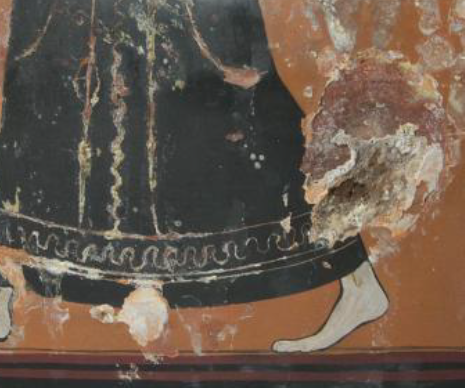
A coleção de vasos gregos do Duque de Palmela entrou em Portugal c. 1834. Incluía a única ânfora (pseudo-)panatenaica numa coleção portuguesa. Na Europa florescia o mercado de antiguidades, a par com restauros, cópias e falsificações. Após a sua aquisição, o MNA decidiu examiná-la por tomografia computorizada e análise de materiais, o que levantou questões de autenticidade. Distintas técnicas analíticas confirmaram a modernidade de camadas de pintura. No entanto, imagens recentes de fluorescência visível induzida por ultravioleta sugerem que algumas áreas podem ser vitrocerâmica preta – uma técnica antiga apenas redescoberta em 1942. À luz das evidências mais recentes, argumenta-se que mais testes serão necessários para esclarecer se este é um vaso antigo com extensas camadas de intervenções modernas ou um produto completamente moderno. O interesse arqueológico e histórico deste vaso torna-se de particular relevância para uma reflexão crítica sobre as distintas técnicas analíticas, práticas de restauro e coleções de antiguidades.
Downloads
Referências
1. Rocha Pereira, M. H., ‘Notícia acerca de vasos gregos existentes em Portugal. IIa parte’, Humanitas 11-12 (1959) 11-58.
2. Lucidi, E., Memorie storiche dell’antichissimo municipio ora terra dell’Ariccia, e delle sue colonie Genzano, e nemi dedicate a Sua Eccellenza Il Signor D. Agostino Chigi ... Dal Canonico Emmanuele Lucidi, Lazzarini, Rome (1796), https://arachne.dainst.org/entity/15883 (accessed 2025-08-20).
3. Degortes, M., ‘Aquisição de móveis e ornamentação para a residência de um diplomata: o gosto de Alexandre Sousa Holstein’, in Actas do III colóquio internacional A casa Senhorial. Anatomia de interiores, eds. G. Vasconcelos Sousa & A. Pessoa, Universidade Católica Editor, Porto (2018) 311–328, https://repositorio.ul.pt/handle/10451/37510 (accessed 2025-08-20).
4. Guerra, A., ‘Alexandre de Sousa e Holstein (1751-1803): o gosto pelas antiguidades e as escavações de Arícia’, in Ex Baetica Romam: Homenaje a José Remesal Rodríguez, eds. V. Revilla Calvo, A. Aguilera Martín, L. Pons Pujol & M. García Sánchez, Universitat de Barcelona, Barcelona (2020) 1439-1469.
5. BAPD, ‘BAPD-9023288’, in Beazley archive pottery database, Classical Art Research Centre, University of Oxford (1997-), http://www.beazley.ox.ac.uk/record/0AAC51D6-07BF-4190-A0A5-3E2B45D62909 (accessed 2025-08-20).
6. Rocha Pereira, M. H., Greek vases in Portugal, Instituto de Estudos Clássicos da Universidade de Coimbra, Coimbra (1962).
7. Rocha Pereira, M. H., Greek vases in Portugal, 1st ed., Imprensa da Universidade de Coimbra, Coimbra (2010), https://doi.org/10.14195/978-989-8281-25-8.
8. Rocha Pereira, M. H., Vasos gregos em Portugal. Aquém das colunas de Hércules, Museu Nacional de Arqueologia, Lisboa (2007).
9. Bentz, M., ‘Appendix 1: Schwarzfigurige pseudo-Preisamphoren (ca. 550-475 v. Chr.)’, in Panathenaïka, symposion zu den Panathenäischen Preisamphoren, Rauischholzhausen, eds. M. Bentz & N. Eschbach, Zabern, Mainz (2001) 177-195.
10. Morais, R., Iberia Graeca. Arte griego en los museos y colecciones de la Península Ibérica, Centro Iberia Graeca, Barcelona (2019).
11. Prates, C.; Moitinho de Almeida, V.; Sousa, S.; Rodrigues, A. L.; Dias, M. I., ‘Palmela’s “pseudo-Panathenaic” amphora: unveiling the truth, more than 200 years later’, in Myths, gods, and heroes. Greek vase collections in Portugal / Mitos, deuses e heróis. As coleções de vasos gregos em Portugal, vol. 2, eds. R. Morais, R. Centeno & D. Ferreira, Câmara Municipal de Santa Maria da Feira – Museu Convento dos Lóios; Reitoria da Universidade do Porto; Faculdade de Letras da Universidade do Porto; Imprensa da Universidade de Coimbra, Porto, Coimbra (2023) 249-268.
12. Dooijes, R., ‘Keeping alive the history of restoration: nineteenth century repairs on Greek ceramics from the National Museum of Antiquities in Leiden’, in ICOM glass and ceramics conservation, interim meeting of the ICOM-CC working group, ed. L. Pilosi, Nova Gorica (2007) 103-112.
13. Bourgeois, B.; Matz, F. (eds.), Une perfection dangereuse, la restauration des vases Grecs, de Naples à Paris, XVIIIe – XIXe siècles, Centre de Recherche et de Restauration des Musées de France (C2RMF), Paris (2010).
14. Tjon Sie Fat, E., Reading restorations. 19th century restorations on red-figure south Italian vases from the National Museum of Antiquities, Leiden University, Leiden (2012), https://hdl.handle.net/1887/19489 (accessed 2025-08-20).
15. Dooijes, R.; Düring. M., ‘The Canino collection: historical restorations on Greek vases in the National Museum of Antiquities in Leiden’, in The Canini connections. The history and restoration of ancient Greek vases from the excavations of Lucien Bonaparte, Prince of Canino (1775-1840), ed. R.B. Halbertsma, Sidestone Press, Leiden (2017) 103-116.
16. Bentz, M., ‘Schwarzfigurige amphoren panathenäischer form. Typologie, funktion und verbreitung’, in Panathenaïka, symposion zu den Panathenäischen Preisamphoren, Rauischholzhausen, eds. M. Bentz & N. Eschbach, Zabern, Mainz (2001) 111-127.
17. Schreiber, T., Athenian vase construction. A Potter’s analysis, The J. Paul Getty Museum, Malibu (1999).
18. Noble, J. V., The techniques of painted Attic pottery, Faber & Faber in cooperation with the Metropolitan Museum of Art (New York), London (1966).
19. Aloupi-Siotis, E., ‘Ceramic technology: how to characterise black Fe-based glass-ceramic coatings’, Archaeological and Anthropological Sciences 12(8) (2020) 191, https://doi.org/10.1007/s12520-020-01134-x.
20. Sparkes, B. A., The red and the black. studies in Greek pottery, Routledge, London, New York (1996).
21. Ingo, G. M.; Bultrini, G.; de Caro, T.; Del Vais, C., ‘Microchemical study of the black gloss on red- and black-figured Attic vases’, Surface and Interface Analysis 30 (2000) 101-105, https://doi.org/10.1002/1096-9918(200008)30:1<101::AID-SIA830>3.0.CO;2-5.
22. Jansen, R.; Koens, H.; Neeft, C.; Stoker, J., ‘Scenes from the past: CT in the archaeology of ancient Greek ceramics’, RadioGraphics 21 (2001) 315-321, https://doi.org/10.1148/radiographics.21.2.g01mr12315.
23. Berg, I., ‘Looking through pots: recent advances in ceramics X-radiography’, Journal of Archaeological Science 35(5) (2008) 1177-1188, https://doi.org/10.1016/j.jas.2007.08.006.
24. Karl, S.; Jungblut, D.; Mara, H.; Wittum, G.; Krömker, S., ‘Insights into manufacturing techniques of archaeological pottery: industrial X-Ray computed tomography as a tool in the examination of cultural material’, in Craft and science: international perspectives on archaeological ceramics, ed. M. Martinón-Torres, Bloomsbury Qatar Foundation, Doha, Qatar (2014) 253-261, https://doi.org/10.5339/uclq.2014.cas.ch27.
25. Ricci, G., Archaeometric studies of historical ceramic materials, Università Ca’ Foscari Venezia, Venice (2016), http://hdl.handle.net/10579/10321 (accessed 2025-08-20).
26. Moitinho de Almeida, V., ‘Contributions of 3D digital methods and techniques to the study of ancient pottery’, in Myths, gods, and heroes. Greek vase collections in Portugal / Mitos, deuses e heróis. As coleções de vasos gregos em Portugal, vol. 2, eds. R. Morais, R. Centeno & D. Ferreira, Câmara Municipal de Santa Maria da Feira – Museu Convento dos Lóios; Reitoria da Universidade do Porto; Faculdade de Letras da Universidade do Porto; Imprensa da Universidade de Coimbra, Porto, Coimbra (2022) 269-291.
27. 3D Slicer, 3D slicer image computing platform (1998-), http://www.slicer.org (accessed 2025-08-20).
28. Fedorov, A.; Beichel, R.; Kalpathy-Cramer, J.; Finet, J.; Fillion-Robin, J.-C.; Pujol, S.; Bauer, C.; Jennings, D.; Fennessy, F.; Sonka, M.; Buatti, J.; Aylward, S. R.; Miller, J. V.; Pieper, S.; Kikinis, R., ‘3D slicer as an image computing platform for the quantitative imaging network’, Magnetic Resonance Imaging 30(9) (2012) 1323-1341, https://doi.org/10.1016/j.mri.2012.05.001.
29. Moitinho de Almeida, V., Towards functional analysis of archaeological objects through reverse engineering processes, Universitat Autònoma de Barcelona, Cerdanyola del Vallès (2013), http://hdl.handle.net/10803/129161 (accessed 2025-08-20).
30. Spelitz, S.; Moitinho de Almeida, V.; Lang-Auinger, C., ‘Automatic geometry, metrology, and visualisation techniques for 3D scanned vessels’, Digital Applications in Archaeology and Cultural Heritage 17 (2020) e00105, https://doi.org/10.1016/j.daach.2019.e00105.
31. Maritan, L., ‘Ceramic abandonment. How to recognise post-depositional transformations’, Archaeological and Anthropological Sciences 12(8) (2020) 199, https://doi.org/10.1007/s12520-020-01141-y.
32. IPPAR, Ficha de laboratório No83, Instituto Português do Património Arquitectónico (IPPAR), Departamento de Arqueologia, Lisbon (1998) 1-6.
33. Petrakova, A., ‘Restoration and conservation of the vases in the 18th-19th centuries’, in Myths, gods, and heroes. Greek vase collections in Portugal / Mitos, deuses e heróis. As coleções de vasos gregos em Portugal, vol. 2, eds. R. Morais, R. Centeno & D. Ferreira, Câmara Municipal de Santa Maria da Feira – Museu Convento dos Lóios; Reitoria da Universidade do Porto; Faculdade de Letras da Universidade do Porto; Imprensa da Universidade de Coimbra, Porto, Coimbra (2022) 236-248.
34. Koob, S., ‘Obsolete fill materials found on ceramics’, Journal of the American Institute for Conservation 37(1) (1998) 49-67, https://doi.org/10.1179/019713698806082958.
35. Millingen, J. V., Peintures antiques et inédites de vases grecs: tirées de diverses collections, avec des explications, Imprimé par de Romanis, Rome (1813), https://doi.org/10.11588/DIGLIT.4842.
36. Moitinho de Almeida, V., 3D archaeological Greek pottery: MNA 999.1.1 (BAPD 9023288), Palmela amphora of Panathenaic shape [Dataset], Zenodo (2025) 1-20, https://doi.org/10.5281/zenodo.16880854.
37. Bentz, M., ‘Les amphores Panathénaïques: une étonnante longévité’, in Le vase grec et ses destins, eds. P. Rouillard & A. Verbanck-Piérard, Biering et Brinkmann, Munich (2003) 111-117.
38. Snow, C. E., ‘The Affecter amphora: a case study in the history of Greek vase restoration’, The Journal of the Walters Art Gallery 44 (1986) 2-7.
39. Bukina, A., ‘Restorations on the Canino vases of the State Hermitage Museum’, in The Canini connections. The history and restoration of ancient Greek vases from the excavations of Lucien Bonaparte, Prince of Canino (1775-1840), ed. R.B. Halbertsma, Sidestone Press, Leiden (2017) 117-124.
40. Schumann, T., ‘Oberflächenverzierung in der antiken Töpferkunst, terra sigillata und griechische Schwarzrotmalerei’, Berichte der Deutschen Keramischen Gesellschaft 23 (1942) 408-426.
41. Schumann, T., ‘Terra sigillata und die Schwarz-Rot-Malerei der Griechen’, Forschungen und Fortschritte 19 (1943) 356-358.
42. Weickert, C., ‘Zur technik der griechischen Vasenmalerei’, Archäologischer Anzeiger (1942) 512-528.
43. Gettens, R. J.; Fitzhugh, E. W., ‘Azurite and blue verditer’, in Artists’ pigments. A handbook of their history and characteristics, vol. 2, ed. A. Roy, National Gallery of Art, Washington (1993) 23-35.
44. Kraft, A., ‘On the discovery and history of prussian blue’, Bulletin for the History of Chemistry of the American Chemical Society 33(2) (2008) 61-67, https://doi.org/10.70359/bhc2008v033p061.
45. Berthollet, C. L.; Vauquelin, L. N., ‘Rapport fait à la classe des sciences physiques et mathématiques de l’Institut, sur un mémoire de M. Godon’, Annales de Chimie 53 (1805) 222-229, http://hdl.handle.net/1908/1038 (accessed 2025-08-20).
46. Kühn, H.; Curran M., ‘Chrome yellow and other chromate pigments’, in Artists’ pigments. A handbook of their history and characteristics, vol. 1, ed. R.L. Feller, National Gallery of Art, Washington (1986) 187-217.
47. Saunders, D.; Trentelman, K.; Maish, J., ‘Collaborative investigations into the production of Athenian pottery’, in New approaches to ancient material culture in the Greek & Roman world, ed. C. Maish, Brill, Leiden, Boston (2020) 124-135, https://doi.org/10.1163/9789004440753_007.
48. Szilágyi, J. G., ‘Wisest is time: ancient vase forgeries’, in Manufacturing a past for the present: forgery and authenticity in medievalist texts and objects in nineteenth-century Europe, eds. J.M. Bak, P.J. Geary & G. Klaniczay, Brill, Leiden, Boston (2014) 171-223, https://doi.org/10.1163/9789004276819.
Downloads
Publicado
Como Citar
Licença
O presente trabalho é distribuído nos termos da Licença Creative Commons (CC BY-NC 4.0) que permite a utilização, partilha e reprodução para fins não comerciais e sem modificações, desde que o autor e fonte original sejam citados.
O Copyright permanece com os autores.