Potentials and limitations of provenance attribution through material analyses: new insights on the Imperial Crown of the Holy Roman Empire
DOI:
https://doi.org/10.14568/cp39270Keywords:
Imperial Crown, Medieval, Gemstones, Enamel, Material analyses, ProvenanceAbstract
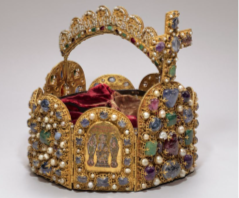
This study discusses the potentials and limitations of non-destructive material analysis by providing insights into the current state of research on the composition and specific characteristics of the materials used for the Imperial Crown, including gold, gemstones, pearls, niello and enamel. The cloisonné enamel plaques are of particular interest, given that glass is a complex mixture of different raw materials. The following complementary non-invasive methods were applied: digital microscopy, X-ray fluorescence analysis, Raman, optical absorption and reflection spectroscopy and multiband imaging. Determining the materiality proved to be a complex task, due to a number of restrictions. These included the limited range of suitable methods, a lack of knowledge regarding specific materials and established manufacturing traditions, such as recycling, or the presence of overlapping characteristics among materials of different origins. Although the origin of the crown itself cannot yet be determined, the analytical results provide a reliable basis for further research.
Downloads
References
1. Schulze-Dörrlamm, M., Die Kaiserkrone Konrads II. (1024 - 1039), 2nd ed., Thorbecke, Sigmaringen (1992).
2. Wolf, G., Die Wiener Reichskrone, Schriften des Kunsthistorischen Museums, vol. 1, Skira, Milano (1995).
3. Eckenfels-Kunst, S., Goldemails. Untersuchungen zu ottonischen und frühsalischen Goldzellenschmelzen, Pro Business, Berlin (2008).
4. Kugler, G., Die Reichskrone, Die Kronen des Hauses Österreich, vol. 5, Herold, Wien, München, (1986).
5. Fillitz, H., ‘Bemerkungen zur Datierung und Lokalisierung der Reichskrone’, Zeitschrift für Kunstgeschichte 56 (1993) 313-334.
6. Ott, J., ‘Kronen und Krönungen in frühottonischer Zeit’, in Ottonische Neuanfänge. Symposion zur Ausstellung "Otto der Große, Magdeburg und Europa, eds. B. Schneidmüller, S. Weinfurter, von Zabern, Mainz (2001) 171-188.
7. Elbern, V.H., ‘Neue Forschungen zur Reichskrone - Signum ottonischer Herrschaftsauffassung?’, Archiv für Diplomatik 43(JG) (1997).
8. Murr, C. G., Beschreibung der sämtlichen Reichskleinodien aus der Handschrift des seel. Herrn Duumviers Hieronymus Wilhelm Ebners von Eschenbach und der Reichsheiligthümer, welche in der des Heil. Röm. Reichs freyen Stadt Nürnberg aufbewahret werden, Nürnberg in Comission der Bauer und Mannischen Buchhandlung (1790.
9. Quiring, H., ‘Die Herkunft der deutschen Kaiserkrone und ihre Edelsteine’, Carinthia II 143/63(2) (1953) 14-22.
10. Groat, L.; Giuliani, G.; Stone-Sundberg, J.; Sun, Z.; Renfro, N.; Palke, A., ‘A review of analytical methods used in geographic origin determination of gemstones’, Gems & Gemology 55(4) (2019) 512-535, http://dx.doi.org/10.5741/GemS.55.4.512.
11. Moss, A., ‘Niello’, Studies in Conservation 1(2) (1953) 49-62, https://doi.org/10.1179/sic.1953.007.
12. La Niece, S., ‘Niello: An historical and technical survey’, The Antiquaries Journal 63(2) (1983) 279-297, https://doi.org/10.1017/S000358150006652X.
13. Greiff, S.; Hartmann, S., ‘Feuervergoldung und Niello am Tassilo-Liutpirc-Kelch: Zusammensetzung und Technik’, in Der Tassilo-Liutpirc-Kelch im Stift Kremsmünster, ed. E. Wamers, Schnell + Steiner, Regensburg (2019) 49-69.
14. Weixlgärtner, A., ‘Die Weltliche Schatzkammer in Wien: Neue Funde und Forschungen’, Jahrbuch der Kunsthistorischen Sammlungen in Wien 1 (1926) 15-84.
15. Kahsnitz, R., ‘Ottonische Emails. Zum Stand der Forschung’, Zeitschrift des deutschen Vereins für Kunstwissenchaften, 52/53 (1998) 114-150.
16. Buckton, D., ‘Enamelling on gold’, Gold Bulletin 15(3) (1982) 101-109, https://doi.org/10.1007/BF03214613.
17. Colomban, P., ‘Colouring agents for glass, glaze and enamel: tracing innovation and exchange Routes’, in: Raman Spectroscopy in Archaeology and Art History, Vol. 2, eds. P., Vandenabeele and H. Edwards, Royal Society of Chemistry, Cambridge (2019) Supplementary information, http://www.rsc.org/suppdata/books/178801/9781788011389/bk9781788011389.pdf (accessed 2024-11-29).
18. Costa, M.; Arruda, A.; Dias, L.; Barbosa, R.; Mirão, J.; Vandenabeele, P., ‘The combined use of Raman and micro-X-ray diffraction analysis in the study of archaeological glass beads’, Journal of Raman Spectroscopy 50(2) (2019) 250-261, https://doi.org/10.1002/jrs.5446.
19. Phelps, M.; Freestone, I.; Gorin-Rosen, Y.; Gratuze, B., ‘Natron glass production and supply in the late antique and early medieval Near East: The effect of the Byzantine-Islamic transition’, Journal of Archaeological Science 75 (2016) 57-71, http://dx.doi.org/10.1016/j.jas.2016.08.006.
20. Kronz, A., ‘Rhenish glass. The role of late antique to early medieval glass production in the Rhineland: a chemichal invetigation’, in Glas als Fernhandelsprodukt im frühen Mittelalter: Köln und der europäische Norden, eds. M. Dodt, A. Kronz, B. Majchczack and S. Messal, Verlag des Römisch-Germanischen Zentralmuseums Mainz, Heidelberg (2022) 233-261, https://doi.org/10.11588/propylaeum.1105.c15180.
21. Schibille, N., Islamic glass in the making. Chronological and geographical dimensions, Leuven University press, Leuven (2022).
22. Freestone, I., ‘The provenance of ancient glass through compositional analysis’, MRS Online Library Proceedings 852 (2004) 188-201, https://doi.org/10.1557/PROC-852-OO8.1.
23. Gratuze, B.; Schibille, N.; Pactat, I., ‘Glass in the middle east and Western Europe at the end of the First Millennium CE: Transition from natron to plant ash soda or forest glasses’, in Ancient glass of South Asia. Archaeology, ethnography and global connections, eds. A. Kanungo and L. Dussubieux, Springer, Singapore (2021) 21-38, https://doi.org/10.1007/978-981-16-3656-1_2.
24. Wedepohl, K. H., ‘The change in composition of medieval glass types occurring in excavated fragments from Germany’, in Annales du 19e congrès de l'Association internationale pour l'histoire du verre, ed. I. Lazar, AIHV, Koper (2000) 253-257.
25. Basso, E.; Invernizzi, C.; Malagodi, M.; La Russa, M. F.; Bersani, D., Lottici, P., ‘Characterization of colorants and opacifiers in roman glass mosaic tesserae through spectroscopic and spectrometric techniques’, Journal of Raman Spectroscopy 45(3) (2014) 238-245, https://doi.org/10.1002/jrs.4449.
26. Buzanich, G.; Wobrauschek, P.; Streli, C.; Markowicz, A.; Wegrzynek, D.; Chinea‐Cano, E.; Griesser, M.; Uhlir K., ‘PART II (Portable ART analyzer): Development of a XRF spectrometer adapted for the study of artworks in the Kunsthistorisches Museum, Vienna’, X-Ray Spectrometry 39(2) (2010) 98-102, https://doi.org/10.1002/xrs.1231.
27. Alberti, R.; Frizzi, T.; Bombelli, L.; Gironda, M.; Aresi, N.; Rosi, F.; Miliani, C.; Tranquilli, G.; Talarico, F.; Cartechini, L., ‘CRONO: a fast and reconfigurable macro X‐ray fluorescence scanner for in‐situ investigations of polychrome surfaces’, X-Ray Spectrometry 46(5) (2017) 297-302, https://doi.org/10.1002/xrs.2741.
28. Nasdala, L.; Lamers, T.; Gilg, H. A.; Chanmuang N. C.; Griesser, M.; Kirchweger, F.; Erlacher, A.; Böhmler, M; Giester, G., ‘The imperial crown of the Holy Roman Empire, Part I: Photoluminescence and Raman spectroscopic study of the gemstones’, The Journal of Gemmology 38(5) (2023) 448-473, https://doi.org/10.15506/JoG.2023.38.5.448.
29. Guerra, M., ‘Physicochemical approaches to gold and silver work, an overview: searching for technologies, tracing routes, attempting to preserve’, Physical Sciences Reviews 4(2) (2018) 1-15, http://dx.doi.org/10.1515/psr-2018-0015.
30. Zwierlein-Diehl, E., ‘Drei antike Amethyst-Intaglien an der Wiener Reichskrone‘, in Jahreshefte des Österreichischen Archäologischen Institutes in Wien, ed. Österreichisches Archäologisches Institut in Wien, Holzhausen Verlag, Wien, (2024) 333-351.
31. Palke, A.; Saeseaw, S.; Renfro, N.; Sun, Z.; Mc Clure, S., ‘Geographic origin determination of blue sapphire’, Gems & Gemology 55(4) (2019) 536-579, http://dx.doi.org/10.5741/gems.55.4.536.
32. Thoresen, L., ‘A case study on gemstone origins: Chrysothrix, a group of Roman magical gems’, in Gems of heaven: recent research on engraved gemstones in late antiquity, c. AD 200-600, eds. C. Entwistle and N. Adams, British Museum, London (2011) 4-9.
33. Calligaro, T.; Colinart, S.; Poirot, J.; Sudres, C., ‘Combined external-beam PIXE and μ-Raman characterisation of garnets used in Merovingian jewellery’, Nuclear Instruments and Methods in Physics 189(1-4) (2002) 320-327, https://doi.org/10.1016/S0168-583X(01)01078-3.
34. Gilg, H. A; Hyršl, J., ‘Garnet mines in europe’, in Rouges et noirs: Rubis, grenat, onyx, obsidienne et autres minéraux rouges et noirs dans l'art et l'archéologie, ed. J. Toussaint, Société archéologique de Namur, Namur (2014) 145-173.
35. Gilg, H. A.; Gast, N.; Calligaro, T., ‘Vom Karfunkelstein: Granat-Cloisonné: der erste europäische Schmuckstil’, in Karfunkelstein und Seide: Neue Schätze aus Bayerns Frühzeit, ed. L. Wamser, Pustet, Regensburg (2010) 87-100.
36. Simonet, C.; Fritsch, E.; Lasnier, B., ‘A classification of gem corundum deposits aimed towards gem exploration’, Ore Geology Reviews 34(1-2) (2008) 127-133, https://doi.org/10.1016/j.oregeorev.2007.09.002.
37. Gilg, H. A.; Grundmann, G., ‘Histoire des anciennes mines d‘émeraude d‘Égypte’, in Émeraudes, tout un monde!, ed. G. Giuliani, Les Editions du Piat, (2022) 161-168.
38. Guo, H.; Yu, X.; Zheng, Y.; Sun, Z., ‘Inclusion and trace element characteristics of emeralds from Swat Valley, Pakistan’, Gems & Gemology 56(3) (2020) 336-355, http://dx.doi.org/10.5741/GEMS.56.3.336.
39. Sturman, N.; Otter, L.; Homkrajae, A.; Nilpetploy, N.; Lawanwong, K.; Kessrapong, P.; Jochum, K.; Stoll, B.; Grotz, H.; Jacob, D., ‘A pearl identification challenge’, Gems & Gemology 55(2) (2019) 229-243, https://doi.org/10.5741/GEMS.55.2.229.
40. Karampelas, S.; Mohamed, F.; Abdulla, H.; Almahmood, F.; Flamarzi, L.; Sangsawong, S.; Alalawi, A., ‘Chemical characteristics of freshwater and saltwater natural and cultured pearls from different bivalves’, Minerals 9(6) (2019) 357, https://doi.org/10.3390/min9060357.
41. Lawler, A., ‘The pearl trade’, Archaeology 65(2) (2012) 46-51, https://www.jstor.org/stable/41781369 (accessed 2024-11-29).
42. Strack, E., Pearls, Rühle-Diebener-Verlag, Stuttgart (2006).
43. Mozgai, V.; Topa, B.; Weiszburg, T.; Mráv, Z.; Bajnóczi, B., ‘SEM–EDS and μ-XRD study of the niello inlays of a unique late Roman silver augur staff (lituus) from Brigetio, Pannonia (Hungary)’, Archaeological and Anthropological Sciences 11(4) (2019) 1599-1610, https://doi.org/10.1007/s12520-018-0750-3.
44. Northover, J.; La Niece, S., ‘New thoughts on niello’, in From mine to microscope. Advances in the study of ancient technology, eds. A. Shortland, I. Freestone and T. Rehren, Oxbow Books, Oxford (2009) 145-154.
45. Röhrs, S.; Lambacher, L.; Tagle, R., ‘Studying the process of enamel powder preparation for émail champlevé by colour measurements and μ‐X‐ray mappings’, Archaeometry 61(2) (2018) 374-391, http://dx.doi.org/10.1111/arcm.12425.
46. Ricciardi, P.; Colomban, P.; Tournié, A.; Macchiarola, M.; Ayed, N., ‘A non-invasive study of Roman Age mosaic glass tesserae by means of Raman spectroscopy’, Journal of Archaeological Science 36(11) (2009) 2551-2559, https://doi.org/10.1016/j.jas.2009.07.008.
47. Bersani, D.; Saviane, L.; Morigi, A.; Mantovani, L.; Aceto, M.; Fornasini, L., ‘Multi‐technique characterization of glass mosaic tesserae from Villa di Teodorico in Galeata (Italy)’, Journal of Raman Spectroscopy 52(12) (2021) 2234-2245, https://doi.org/10.1002/jrs.6180.
48. Möncke, D.; Palles, D.; Palamara, E.; Papageorgiou, M.; Kamitsos, E., Zacharias, N., ‘Coloring vitreous materials: pigments, colloids, and ions in glasses and glazes from the Mycenaean to Medieval periods: probed by spectroscopic techniques’, in Proceedings of the 3rd ARCH_RNT Conference, University of the Peloponnese|, (2014) 153-164.
49. Röhrs, S.; Fenoglio, G.; Reiche, I.; Lambacher, L., ‘Studying glass on metal: Raman analysis of medieval champlevé enameled objects’, Journal of Raman Spectroscopy 52(1) (2021) 23-34, https://doi.org/10.1002/jrs.5934.
50. Biron, I.; Beauchoux, S., ‘Ion beam analysis of Mosan enamels‘, Measurement Science and Technology 14(9) (2003) 1564-1578, https://doi.org/10.1088/0957-0233/14/9/308.
51. Gilg, A. H.; Karampelas, S.; Lamers, T.; Uhlir, K.; Griesser, M.; Kirchweger, F., ‘The Imperial Crown of the Holy Roman Empire, Part II: Origin Determination of the Gemstones and Pearls’, The Journal of Gemmology 39(8) (2025) 740-770, https://doi.org/10.15506/JoG.2025.39.8.740.
Downloads
Published
How to Cite
License
This work is distributed under a Creative Commons Attribution License (CC BY-NC-ND 4.0) which permits use, distribution, and reproduction in any medium following no commercial or derivatives, provided the original author and source are credited.
Copyright remains with the authors.