Uso da imagem de raios X para monitorizar a condição interna de madeira arqueológica encharcada – pré-, intra- e pós-conservação
DOI:
https://doi.org/10.14568/cp39271Palavras-chave:
Madeira arqueológica saturada de água, Conservação, Condição, Raios XResumo
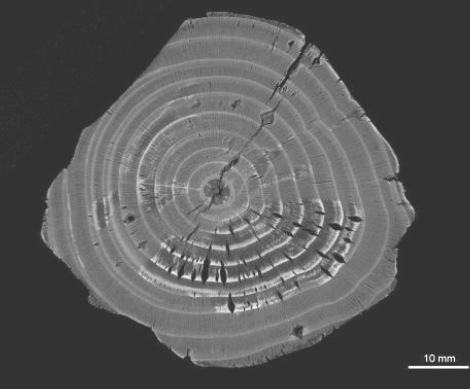
Durante o tratamento de conservação, a maior ameaça aos objetos arqueológicos de madeira saturada de água (WAW) é o colapso e/ou contração, que podem ocorrer durante o processo de secagem. Trabalhos recentes realizados pelo projeto CuTAWAY revelaram, utilizando micro-tomografia computadorizada (micro-CT), que a extensão das alterações estruturais adversas encontradas internamente nos WAW conservados era muito maior do que o geralmente previsto. Sugerindo a necessidade de os conservadores monitorizarem e avaliarem a condição interna dos WAW antes, durante e após o tratamento. Neste estudo, verificou-se que a imagem por raios X oferece uma alternativa mais rápida e amplamente disponível à micro-CT. Embora as imagens tenham uma resolução inferior às obtidas por micro-CT, permitiram identificar a grande maioria dos danos internos presentes numa série de amostras durante várias etapas do tratamento. No entanto, a interpretação correta dos danos internos nas imagens de raios X requer um conhecimento prévio do material lenhoso.
Downloads
Referências
1. Kaye, B., ‘Conservation of waterlogged archaeological wood’, Chemical Society Reviews 24(1) (1995) 35-43, https://doi.org/10.1039/CS9952400035.
2. Historic England, Waterlogged wood: guidelines on the recording, sampling, conservation and curation of waterlogged wood, Historic England Publications, Swindon (2010), https://historicengland.org.uk/images-books/publications/waterlogged-wood/ (accessed 2024-10-30).
3. Pedersen, N. B., Microscopic and spectroscopic characterisation of waterlogged archaeological softwood from anoxic environments, University of Copenhagen, Frederiksberg (2015).
4. Singh, A, P., ‘A review of microbial decay types found in wooden objects of cultural heritage recovered from buried and waterlogged environments’, Journal of Cultural Heritage 13(3) (2012) 16-20, https://doi.org/10.1016/j.culher.2012.04.002.
5. Haque, N., ‘Delamination in timber induced by drying’, in Delamination in Wood, wood products and wood-based composites, ed. V. Bucur, Springer Netherlands, Dordrecht (2011) 197-212, https://doi.org/10.1007/978-90-481-9550-3_10.
6. Fu, Z.; Jiaxing, C.; Yongyue, Z.; Feifan, X.; Yun, L. ‘Review on wood deformation and cracking during moisture loss’, Polymers 15(15) (2023) 3295, https://doi.org/10.3390/polym15153295.
7. Grattan, D. W.; Clarke, R. W., ‘Conservation of waterlogged wood’, in Conservation of marine archaeological objects, ed. C. Pearson, Butterworths, London (1987) 164-206, https://doi.org/10.1016/B978-0-408-10668-9.50015-0.
8. Jensen, P., ‘Sorption of water and water soluble agents in the waterlogged wooden cell wall’, in Proceedings of the 6th ICOM Group on wet organic archaeological materials conference, eds. P. Hoffmann, T. Daly, T. Grant & J. Spriggs, Druckerei Ditzen GmbH und Co., Bremerhaven (1997) 399-434.
9. Strætkvern, S., ‘Vacuum freeze-drying of waterlogged archaeological wood and selecting the impregnation agent prior to drying’, in Proceedings of the international experts’ meeting on the extraction and conservation of the Wreck Mazarrón 2, eds. M. A. Garcia, R. C. Belinchon & C. C. Escribano, Ministerio de Cultura, Madrid (2023) 303-314.
10. Johns, D. A., ‘Post-excavation treatment methods for waterlogged organic archaeological materials: the last twenty years’, in The Oxford handbook of wetland archaeology, eds. F. Menotti & A. O'Sullivan, Oxford Academic, Oxford (2012) 664-684, https://doi.org/10.1093/oxfordhb/9780199573493.013.0040.
11. Stelzner, I.; Stelzner, J.; Martinez-Garcia, J.; Gwerder, D.; Wittköpper, M.; Muskalla, W.; Cramer, A.; Heinz, G.; Egg, M.; Schuetz, P., ‘Evaluation of conservation methods for archaeological wet wood with structured light 3D scanning and µ-CT’, in Proceedings of the 15th ICOM-CC Group on wet organic archaeological materials conference, eds. I. Hovmand, M. Felter & I. Stelzner, ICOM-CC, Mainz (2023) 96-105.
12. Mardikian, P.; Chemello, C., ‘Conservation laboratory design’, in Encyclopedia of global archaeology, ed. C. Smith, Springer, Cham (2018) 1-7, https://doi.org/10.1007/978-3-319-51726-1_433-2.
13. Evans, P. D., ‘The effects of incising on the checking of wood: a review’, International Wood Products Journal 7(1) (2016) 12-25, https://doi.org/10.1080/20426445.2015.1112936.
14. Yang, D-Q.; Normand, D., Best practices to avoid hardwood checking Part I. Hardwood checking – the causes and prevention, FPInnovations - Transorfmative Technologies Program, Quebec (2012).
15. Pearson, H.; Donaldson, L.; Kimberley, M.; Davy, B., ‘Supercritical CO2 drying of New Zealand Red Beech to below the fibre saturation point reduces collapse distortion’, Wood Science and Technology 58(2) (2024) 459-483, https://doi.org/10.1007/s00226-023-01509-y.
16. Richter, C., ‘Overview of cracks/shake forms and causes’, in Wood characteristics: description, causes, prevention, impact on use and technological adaptation, ed. C. Richter, Springer International Publishing, Cham (2015) 199-208, https://doi.org/10.1007/978-3-319-07422-1_8.
17. Putoczki, T. L.; Nair, H.; Butterfield, B.; Jackson, S. L., ‘Intra-ring checking in Pinus Radiata D. Don: the occurrence of cell wall fracture, cell collapse, and lignin distribution’, Trees 21(2) (2007) 221-229, https://doi.org/10.1007/s00468-006-0114-y.
18. Grattan, D. W., ‘Waterlogged wood’, in Conservation of marine archaeological objects, ed. C. Pearson, Butterworths, London (1987) 55-67, https://doi.org/10.1016/B978-0-408-10668-9.50009-5.
19. ‘Mass Finds in Archaeological Collections’, in RGZM, https://www1.rgzm.de/kur/ (accessed 2024-03-13).
20. Bond, J.; Donaldson, L.; Hill, S.; Hitchcock, K., ‘Safranine fluorescent staining of wood cell walls’, Biotechnic & Histochemistry 83(3-4) (2008) 161-171, https://doi.org/10.1080/10520290802373354.
21. Wheeler, E.; Baas, P.; Gasson, P., ‘IAWA list of microscopic features for hardwood identification’, IAWA Bulletin 10(3) (1989) 219-332.
22. Richter, H. G.; Grosser, D.; Heinz, I.; Peter, E., ‘IAWA list of microscopic features for softwood identification’, IAWA journal 25(1) (2004) 1-70.
23. Jensen, P.; Gregory, D. J., ‘Selected physical parameters to characterize the state of preservation of waterlogged archaeological wood: a practical guide for their determination’, Journal of Archaeological Science 33(4) (2006) 551-559, https://doi.org/10.1016/j.jas.2005.09.007.
24. Sluiter, A.; Hames, B.; Ruiz, R.; Scarlata, C.; Sluiter, J.; Templeton, D., ‘Determination of ash in biomass (NREL/TP-510-42622)’, in National Renewable Energy Laboratory Technical Report 19, National Renewable Energy Laboratory, Golden Colorado (2005).
25. Feldkamp, L. A.; Davis, L. C.; Kress, J. W., ‘Practical cone-beam algorithm’, Journal of the Optical Society of America A1 (1984) 612-619.
26. Niemz, P.; Sonderegger, W.; Keplinger, T.; Jiang, J.; Lu, J., ‘Physical properties of wood and wood-based materials’, in Springer handbook of wood science and technology, eds. P. Niemz, A. Teischinger & D. Sanberg, Springer International Publishing, Cham (2023) 281-353.
27. de Jong, J., ‘Conservation techniques for old archaeological wood from shipwrecks found in the Netherlands’, in Biodeterioration investigation techniques, ed. A. H. Walters, Applied Science, London (1977) 295-338.
28. Hedges, J. I., ‘The chemistry of archaeological wood’, in Archaeological wood. properties, chemistry and preservation, eds. R. M. Rowell & R. J. Barbour, American Chemical Society, Washington D. C. (1990) 111-139.
29. Passialis, C. N., ‘Physico-chemical characteristics of waterlogged archaeological wood’, Wood Research and Technology 51(2) (1997) 111-113, https://doi.org/10.1515/hfsg.1997.51.2.111.
30. McConnachie, G.; Eaton, R.; Jones, M., ‘A re-evaluation of the use of maximum moisture content data for assessing the condition of waterlogged archaeological wood’, E-preservation Science 5 (2008) 29-35.
31. Gryc, V.; Vavrčík, H.; Horn, K., ‘Density of juvenile and mature wood of selected coniferous species’, Journal of Forest Science 57(3) (2011) 123-130, https://doi.org/10.17221/18/2010-JFS.
32. Withers, P. J.; Bouman, C.; Carmignato, S.; Cnudde, V.; Grimaldi, D.; Hagen, C. K.; Maire, E.; Manley, M.; Du Plessis, A.; Stock, S.R., ‘X-ray computed tomography’, Nature Reviews Methods Primers 1 (2021) 18, https://doi.org/10.1038/s43586-021-00015-4.
33. Almkvist, G.; Persson, I.,‘Extraction of iron compounds from wood from the Vasa’, Holzforschung 60(6) (2006) 678-684, https://doi.org/10.1515/HF.2006.114.
Downloads
Publicado
Como Citar
Edição
Secção
Categorias
Licença
O presente trabalho é distribuído nos termos da Licença Creative Commons (CC BY-NC 4.0) que permite a utilização, partilha e reprodução para fins não comerciais e sem modificações, desde que o autor e fonte original sejam citados.
O Copyright permanece com os autores.