Does reading the Venice Charter help the good Lord when He moves out? Considerations for expanding the Venice Charter to prevent the loss of church monuments
DOI:
https://doi.org/10.14568/cp36736Keywords:
Church preservation, Guidelines, Reuse, Venice Charter, Vitruvian principles, Monument criteriaAbstract
The Catholic Church owns too many monuments and too few members to maintain them. A true loss for our society is looming. Experts in preservation, politicians, and Church officials are aware of the problem. They respond with resolutions and guideline documents. The compliance of the Charter exerts a restraining influence on the development of responsible strategies for dealing with the abandonment of monuments. Examining the situation of the Church, shows the importance to enhance the priority of this desideratum. Holzhausen is developing an instrument from Vitruvius's criteria for buildings (firmitas, utilitas, venustas) to address it. She complements the terms with historia to achieve and reinforce the heritage conservation emphasis. Holzhausen’s concept enables a process of dialogue between owners, users and professionals when a decision on disposal of a monument becomes necessary. The inclusion of this concept in the Charter would be decisive and should warrant a sustained shift in perspective.
Downloads
References
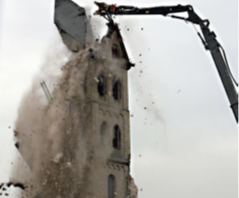
1. ‘The former Roman Catholic Church of St. Lambertus in Immerath’, in Wikimedia Commons, https://commons.wikimedia.org/wiki/File:Immerath_sankt_lambertuskirche.jpg, accessed 2017-08-17)
2. ‘Transara’, in Universität Bonn, https://www.transara.uni-bonn.de/de (accessed 2025-05-20).
3. ‘Kirchenmanifest’, in moderneREGIONAL, https://www.moderne-regional.de/kirchenmanifest/#manifest (accessed 2025-05-20).
4. ‘Schönborn siegt im Streit um Pfarr-Schenkung’, in Die Presse (2014), https://www.diepresse.com/1570320/schoenborn-siegt-im-streit-um-pfarr-schenkung (accessed 2024-02-15).
5. Kant, I., Critik der reinen Vernunft, Johann Friedrich Hartnoch, Riga (1781), Einleitung, p 32 ff.
6. Arbeitsgemeinschaft BWM-Feller-Tabor; Bernhard, E.; Zimmermann, L; Feller, B.; Tabor J., Entwicklung einer Bewertungsmethodik der Architektur von 1945 bis 1979, Wehdorn Architekten ZT GmbH BRNO WIEN, Wien-Brno (2013) https://www.bwm.at/de/projects/bewertungsmethodik-der-nachkriegsarchitektur/ (accessed 2024-02-15).
7. Pope Francis, Apostolic exhortation, Evangelii Gaudium, of the Holy Father, Francis to the bishops, clergy, consecrated persons and the lay faithful on the proclamation of the Gospel in today’s world, Vatican Press, Vatican (2013) https://www.vatican.va/content/francesco/en/apost_exhortations/documents/papa-francesco_esortazione-ap_20131124_evangelii-gaudium.html (accessed 2024-02-15).
8. Bazil, C.; Binder-Kriegelstein, R.; Kraft N., Österreichisches Denkmalschutzrecht, 2nd ed., Manz, Vienna (2015).
9. Stamm, K., ‘Il monumento per l’uomo. Zur Entstehungsgeschichte der Charta von Venedig im Kontext der europäischen Nachkriegszeit’, Österreichische Zeitschrift für Kunst und Denkmalpflege LXIX(1/2) (2015) 20-26.
10. Lehne, A., ‘Die DNA der Charta von Venedig’, Österreichische Zeitschrift für Kunst und Denkmalpflege LXIX(1/2) (2015) 27-32.
11. Falser, M., ‘Theory-Scapes transkulturell: Zur Karriere des Begriffs der Authentizität in der globalen Denkmalpflege’, Österreichische Zeitschrift für Kunst und Denkmalpflege LXIX(1/2) (2015) 33-40.
12. Caviezel, N., ‘Die erodierte Stadt. Das Wiener Memorandum und die Folgen’, Österreichische Zeitschrift für Kunst und Denkmalpflege LXIX(1/2) (2015) 41-50.
13. Langini, A., ‘Monumenta. Zu Programm und Problemen der deutschsprachigen Sammlung von internationalen Grundsatzpapieren und Richtlinien der Denkmalpflege in Theorie und Praxis’, Österreichische Zeitschrift für Kunst und Denkmalpflege LXIX(1/2) (2015) 128-129.
14. ICOMOS, The Nara Document on Authenticity (1994), http://www.icomos.org/en/386-the-nara-document-on-authenticity-1994 (accessed 2024-02-15).
15. ‘Vienna Memorandum on World Heritage and Contemporary Architecture – Managing the Historic Urban Landscape’, Annexe 3, Report of the Secretariat on its activities and on the implementation of the decisions of the World Heritage Committee (WHC-05/15.GA/INF.7) (2005), whc05-15ga-inf7e.doc (accessed 2024-02-15).
16. Oeter, M., Die Suche nach der Differenz, Bielefeld (2021), https://doi.org/10.1515/9783839456866.
17. Mayer, H. R., ’50 Jahre Charta von Venedig, Geschichte, Rezeption, Perspektiven’, Österreichische Zeitschrift für Kunst und Denkmalpflege LXIX(1/2) (2015) 156-157.
18. Parliamentary Assembly, Resolution 916, 9.05.1989, https://pace.coe.int/en/files/16327/html (accessed 2024-02-15).
19. Stovel, H.; Stanley-Price, N.; Killick, R. (eds.), Conservation of living religious heritage − Conservation of living religious heritage, papers from the ICCROM 2003 forum on living religious heritage: conserving the sacred, ICCROM, Rome (2005), http://www.iccrom.org/publication/conservation-living-religious-heritage (accessed 2024-02-15).
20. Carlo-Stella, C., ‘Religious heritage as a meeting point for dialogue’, Conservation of living religious heritage, papers from the ICCROM 2003 forum on living religious heritage: conserving the sacred, eds. H. Stovel, N. Stanley-Price, R. Killick, ICCROM, Rome (2005) 107-111; http://www.iccrom.org/publication/conservation-living-religious-heritage (accessed 2024-02-15).
21. Gian Franco Ravasi, the Pontifical Council for Culture of the Roman Curia (ed.), Decommissioning and ecclesial reuse of churches, Vatican (2018) https://www.cultura.va/content/dam/cultura/docs/pdf/beniculturali/guidelines.pdf (accessed 2024-02-15).
22. ‘Invisibilis - der Kirchenwiederfinder’, in moderneRegional (2016), https://www.moderne-regional.de/listing-category/kirchen/ (accessed 2025-05-19).
23. Deutsche Bischofskonferenz (DBK) (ed.), Arbeitshilfe 175, Umnutzung von Kirchen, Beurteilungskriterien und Entscheidungshilfen (2003), https://www.dbk.de/fileadmin/redaktion/veroeffentlichungen/arbeitshilfen/AH_175.pdf (accessed 2024-02-15).
24. Bistum Aachen (ed.), Handreichung zur Profanierung und Umnutzung von Kirchen und Kapellen im Bistum Aachen (2015), https://www.bistum-aachen.de/export/sites/Bistum-Aachen/portal-bistum-aachen/gemeindearbeit/.galleries/downloads/Handreichung-Profanierung-u.-Umnutzung-Kirchen-u.-Kapellen-Bistum-Aachen.pdf (accessed 2025-05-19).
25. Bistum Aachen (ed.) Kriterien zur Einstufung von Pfarrkirchen und sogenannten Zweit-kirchen (2013), https://www.bistum-aachen.de/export/sites/Bistum-Aachen/portal-bistum-aachen/gemeindearbeit/.galleries/downloads/Kriterien-zur-Einstufung-von-Kirchen.pdf (accessed 2025-05-19).
26. Holzhausen, E., ‘Haec autem ita fieri debent, ut habeatur ratio firmitatis, utilitatis venustatis, Überlegungen zu der notwenigen Trennung von Kirchengebäuden in der katholischen Kirche’, Kirchen Bau Kultur, Zur Verabschiedung von Martin Struck, Erzdiözesanbaumeister von Köln, Siegburg (2023) 59-75.
27. Lienhardt, E.; Rauch, M. (eds.), Orientierungshilfe Kirchen(um)nutzung, Kirchliches Verordnungsblatt der Diözese Graz Seckau, Bischöfliches Ordinariat Graz Seckau (2021), https://www.katholische-kirche-steiermark.at/dl/uOupJmoJkoKnJqx4KJKJKJKMoL/KVBL_2021_12_pdf (accessed 2024-02-15).
28. Pollio, M. V., Vitruv, De architectura libri decem, zweisprachig, übersetzt und durch Anmerkungen und Zeichnungen erläutert von Franz Reber, Wiesbaden (2012) 36-37.
29. CODEX IURIS CANONICI, Can. 1216, https://www.vatican.va/archive/cod-iuris-canonici/deu/documents/cic_libro4_cann1214-1222_ge.html (accessed 2024-02-22).
Downloads
Published
How to Cite
Issue
Section
Categories
License
This work is distributed under a Creative Commons Attribution License (CC BY-NC-ND 4.0) which permits use, distribution, and reproduction in any medium following no commercial or derivatives, provided the original author and source are credited.
Copyright remains with the authors.